
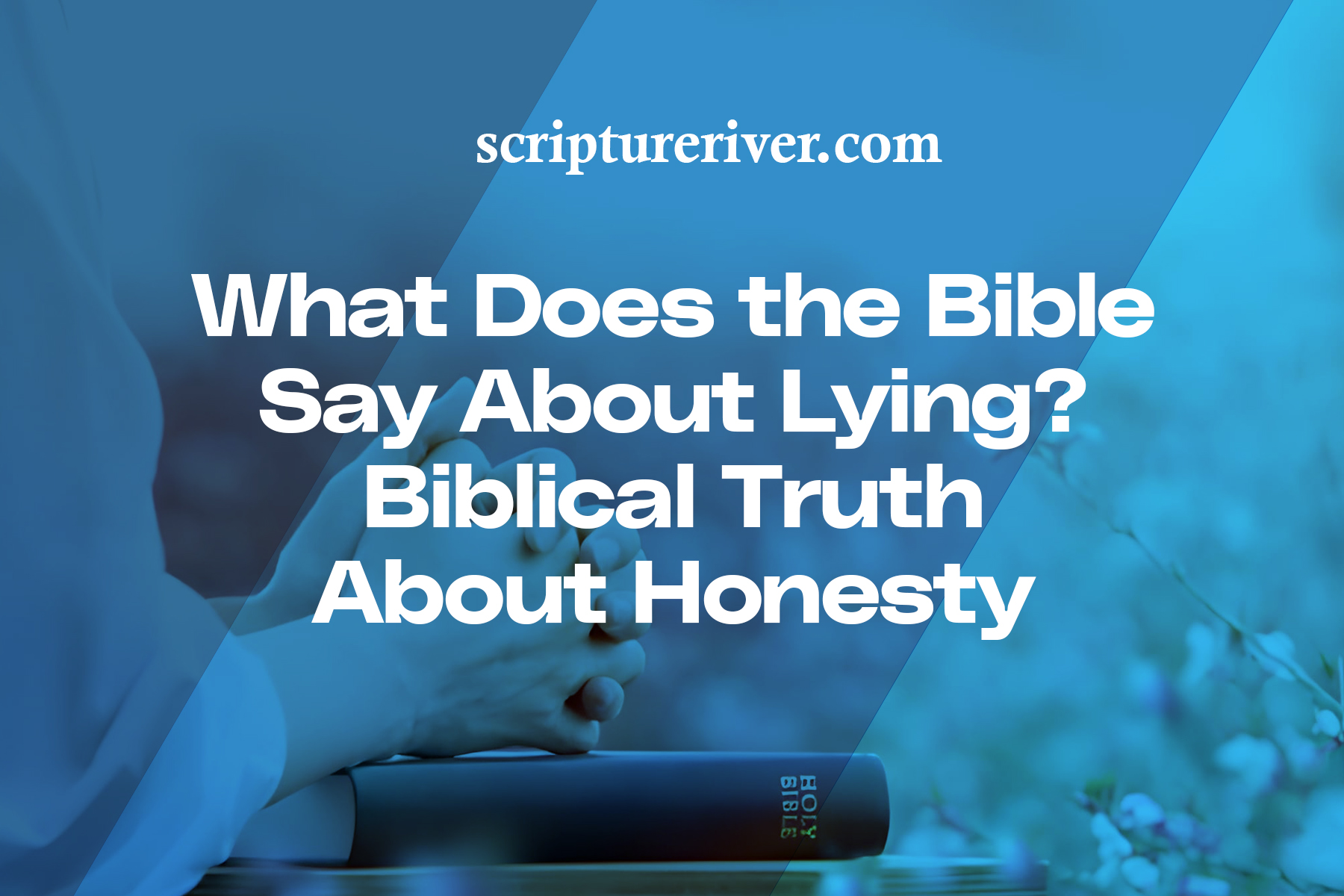
Lying is older than any human law against it.
The first recorded act of deception in Scripture happens before any commandment was given, before any nation existed, before any court could render a verdict.
A serpent told a woman that God had withheld something good from her.
That single distortion of truth set the entire human story on a different course.
This is why the Bible treats lying as more than a social problem. It is a theological one.
Understanding what Scripture says about dishonesty requires understanding where lying comes from, what it does to the people involved, and what God offers in its place.
Lying Has a Source
Jesus makes the clearest statement about the origin of lying in John 8:44:
“You are of your father the devil, and your will is to do your father’s desires. He was a murderer from the beginning, and does not stand in the truth, because there is no truth in him. When he lies, he speaks out of his own character, for he is a liar and the father of lies.” (ESV)
The language here is precise.
Jesus does not say Satan tells lies. He says lying is Satan’s native language, the thing he speaks out of his own character.
Deception is not a strategy the enemy employs. It is what he is.
This has practical consequences.
When a person lies, Scripture is saying they are aligning themselves with a particular character and a particular kingdom.
That is not abstract theology. It is why Colossians 3:9-10 connects stopping lying to identity:
“Do not lie to one another, since you have put off the old man with his deeds, and have put on the new man who is renewed in knowledge according to the image of Him who created him.” (NKJV)
The old self lied because the old self belonged to the wrong father.
The new self, being remade into the image of God, is remade into the image of one who cannot lie (Titus 1:2).
Honesty, in Paul’s framing, is not a discipline. It is a description of who you now are.
What God Says Directly
The Bible does not leave lying in the realm of implication. It addresses it directly, repeatedly, and without qualification.
Leviticus 19:11 is as plain as language gets:
“Do not lie. Do not deceive one another.” (NLT)
This is God speaking to His people as a community. Deception is never only personal. Every lie damages the shared fabric of trust that holds relationships, families, and communities together.
The ninth commandment extends this to the public sphere:
“Thou shalt not bear false witness against thy neighbour.” (KJV)
False witness in a legal context could cost a person their freedom or their life. But the principle reaches further than courtrooms.
It includes how people speak about one another in private, in gossip, in rumor, and in reputation-shaping conversation.
Proverbs 6:16-19 lists the things God hates, and a lying tongue appears at the top:
“There are six things the Lord hates, seven that are detestable to him: haughty eyes, a lying tongue, hands that shed innocent blood, a heart that devises wicked schemes, feet that are quick to rush into evil, a false witness who pours out lies and a person who stirs up conflict in the community.” (HCSB)
Lying appears twice: as a lying tongue and as a false witness. That repetition in a list of seven is not a coincidence.
The word translated “detestable” carries weight. God is not mildly displeased by dishonesty. The emotional register Scripture uses is strong.
Proverbs 12:22 draws the sharpest possible contrast:
“The Lord detests lying lips, but he delights in people who are trustworthy.” (NIV)
Detest and delight. Two poles. A person builds their life on one end or the other.
The Real Cost of Lying
One of the things people most commonly misunderstand about lying is how expensive it actually is.
The short-term calculation almost always favors the lie. It avoids the difficult conversation, protects the comfortable arrangement, and buys time.
The biblical record is clear that the math does not hold.
Proverbs 21:6 describes a fortune built through dishonesty as a vapor, something real for a moment and gone without a trace.
The thing deception builds is inherently unstable because it rests on a foundation that must be continuously maintained. Every lie requires more lies to support it.
The cost runs deeper than practical instability. Proverbs 26:28 names what is actually happening in the moral interior of a liar:
“A lying tongue hates those it hurts, and a flattering mouth works ruin.” (NIV)
Solomon connects deception with hatred. Not frustration. Not weakness. Hatred.
When a person lies to someone, something in them has chosen their own interests over the dignity of the person being deceived.
That is what hatred does.
The account of Ananias and Sapphira in Acts 5 shows what this looks like when deception is directed at God’s people.
A couple lies about a financial offering to appear more generous than they are. Peter’s response is stark:
“Why has Satan filled your heart to lie to the Holy Spirit?” (ESV)
The lie was to the community but against the Spirit. Both of them died.
The story functions in Acts as a warning about what dishonesty does to the integrity of a gathered community of believers.
The Question of “Justified” Lying
Scripture does contain accounts that complicate the picture.
The Hebrew midwives in Exodus 1 lied to Pharaoh to protect the lives of Israelite infants, and God blessed them.
Rahab lied to protect the spies in Jericho and is commended in Hebrews 11 for her faith.
These accounts have generated significant theological discussion.
Some argue that they demonstrate that lying is sometimes the lesser of two evils.
Others argue that God blessed the underlying act of protection, not the deception itself.
The text does not settle the question explicitly in either case.
What the Bible never does is provide a blanket permission for lying whenever the outcome seems good.
Proverbs 6:16-19 contains no exception clause.
Romans 3:8 directly refutes the idea that good ends justify sinful means.
The argument that the end justifies the means is precisely what Scripture refuses to endorse.
Most theologians who have wrestled with these texts land in a similar place: habitual deception as a character trait and a life pattern is what Scripture condemns most forcefully.
The rare, desperate act of protecting innocent life in an extreme situation is treated differently, without ever becoming a general license to deceive.
What Honesty Actually Looks Like
Ephesians 4:15 sets the standard with a phrase easy to read past: “speaking the truth in love” (NIV). Two words doing critical work. Truth and love together.
Truth without love becomes a weapon. Love without truth becomes flattery.
Paul holds both because honesty stripped of care for the person being spoken to is not biblical honesty. It is cruelty given a righteous frame.
Matthew 5:37 gives the simplest possible description of honest communication:
“Just say ‘yes’ and ‘no.’ When you manipulate words to get your own way, you go wrong.” (MSG)
Jesus is describing a life so consistently truthful that no oath or elaborate verification is needed. The words mean what they say.
This kind of integrity is not achieved through willpower. It is cultivated through consistent practice, rooted in the character of a God who keeps His word perfectly.
Psalm 15:1-2 frames honesty as a condition of nearness to God:
“Lord, who may dwell in your sacred tent? Who may live on your holy mountain? The one whose walk is blameless, who does what is righteous, who speaks the truth from their heart.” (NIV)
The phrase “from their heart” is the key. Not performed honesty. Not strategic truth-telling when the cost is low. Truth that starts in the interior before it appears in speech.
Zechariah 8:16 connects honest speech to just community:
“Speak the truth to each other, and render true and sound judgment in your courts.” (NET)
Truthfulness between people is the precondition for everything else functioning well. Courts, families, churches, and friendships all depend on people meaning what they say.
Forgiveness and the Path Forward
The pervasive reach of dishonesty in human life means this subject cannot end with condemnation alone. First John 1:9 is the hinge:
“If we confess our sins, He is faithful and just to forgive us our sins and to cleanse us from all unrighteousness.” (AMP)
Confession is itself an act of honesty. It is refusing to lie to God about what you have done. And the promise attached to it is not conditional on the severity of what was confessed. The forgiveness covers all of it.
John 8:32 points toward what life after deception looks like:
“You will know the truth, and the truth will set you free.” (NIV)
This phrase has been repeated so often it can lose its force. The freedom being described is real.
The person who does not have to maintain a web of stories, who does not have to remember which version they told to whom, carries a lightness that the lying life cannot produce.
Proverbs 10:9 names it plainly:
“Whoever walks in integrity walks securely, but whoever takes crooked paths will be found out.” (NASB)
Security and integrity are not separate things. They are the same thing. The life built on truth does not have to be afraid.
A Prayer for a Truthful Heart
Lord, I know where lying comes from, and I know what it costs. I have paid that cost myself, and I have made others pay it.
Forgive me for the lies I have told and for the truths I have withheld. Forgive me for the deceptions I dressed up as kindness.
Give me a heart that wants truth before it wants comfort. Teach me to speak what is true, even when it costs me something. Let my yes mean yes and my no mean no.
Make me someone You delight in.
In Jesus’ name, amen.
Frequently Asked Questions About Lying and Honesty in the Bible
Is lying always a sin according to the Bible?
The Bible consistently treats lying as sin, but some passages raise complexity. GotQuestions notes cases like the Hebrew midwives in Exodus 1, who lied to protect lives. Most theologians agree that Scripture condemns deception as a pattern and character trait most forcefully, treating extreme protective acts differently.
What does the Bible say white lies are?
Scripture makes no “white lie” exception. Proverbs 12:22 states that God detests lying lips without qualification. GotQuestions points out that justifying white lies relies on “the end justifies the means” logic, a framework the Bible does not support. Small deceptions also tend to grow and compound.
Can God forgive lying?
Yes. First John 1:9 states that God is faithful and just to forgive all confessed sin. No specific lie is beyond the reach of God’s forgiveness. The path back is honest confession and a genuine turn toward truthfulness, not simply feeling regret about what was said.
Why does the Bible say Satan is the father of lies?
Jesus makes this statement in John 8:44. Deception originates in Satan’s nature, not in God’s. God cannot lie (Titus 1:2). Satan has no truth in him. Lying aligns a person with Satan’s character rather than God’s, which is why Scripture treats dishonesty as a serious spiritual matter.
How can a Christian stop lying?
Scripture points to identity change, not behavior management. Colossians 3:9-10 ties stopping lying to putting on the new self in Christ. Compelling Truth advises speaking truth in love (Ephesians 4:15), staying accountable to others, and renewing the mind through God’s Word rather than relying on willpower alone.
Cited Sources
Groeschel, Craig. Winning the War in Your Mind: Change Your Thinking, Change Your Life. Zondervan, 2021.
Wiersbe, Warren W. Be Skillful: God’s Guidebook to Wise Living. David C. Cook, 2009.
Gempf, Conrad. Jesus Asked: What He Wanted to Know. Zondervan, 2003.
Is Lying a Sin? What Does the Bible Say About Lying? GotQuestions.org.
What Does the Bible Say About White Lies? GotQuestions.org.
Is Lying Justified? Answers in Genesis.
Is Lying a Sin? Compelling Truth.
What Does the Bible Say About Lying? Watermark Waves.
What Does the Bible Say About Lying? The Hope Line.
Alcorn, Randy. The Treasure Principle. Multnomah, 2017.

