
I remember a few years ago when a young woman sat in my office sobbing uncontrollably.
“I’ve committed the unforgivable sin,” she said.
“I cursed at God when I was angry. I’ve asked for forgiveness a thousand times. But I can’t feel His presence anymore. I think I’m damned forever.”
She wasn’t the first person to sit in that chair with that fear. And she wouldn’t be the last.
The “unforgivable sin” terrifies believers.
They’re convinced they’ve accidentally committed it through a moment of anger, a blasphemous thought, or rejecting God during a season of doubt.
Here’s the truth: if you’re worried you’ve committed the unforgivable sin, you haven’t.
The very fact you’re concerned proves it.
Let me explain what blasphemy against the Holy Spirit actually is and why most people completely misunderstand it.
Audio Overview: Understanding the Unforgivable Sin
If you’re terrified you’ve committed blasphemy against the Holy Spirit, listen to this 13-minute message first.
You’ll discover why the very fact you’re worried proves you haven’t done it, what Jesus actually meant in His warning to the Pharisees, and how to find peace when fear of this sin is tormenting you.
This brief audio overview will help you understand that God’s grace is bigger than your worst fears and that the unforgivable sin isn’t what most Christians think it is.
What Jesus Actually Said About the Unforgivable Sin
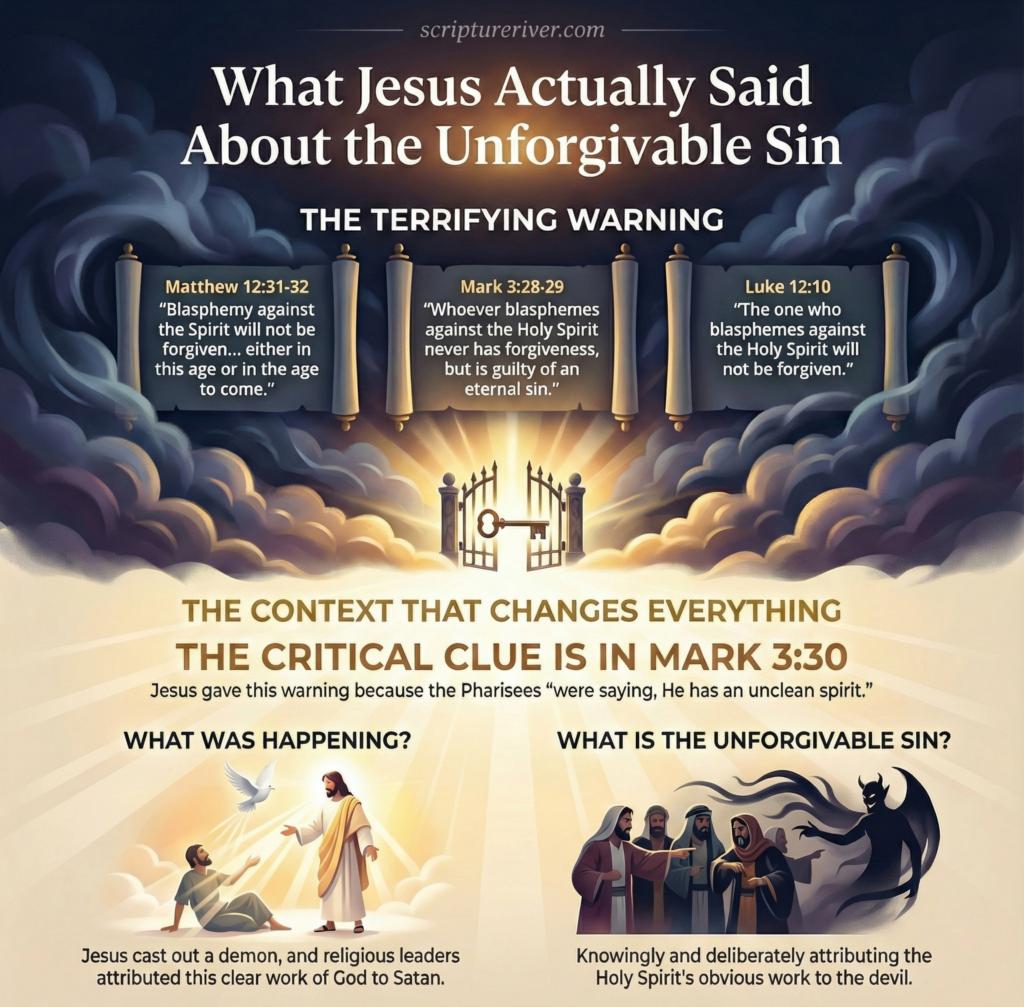
The teaching about blasphemy against the Holy Spirit appears in three Gospels. Context is everything.
Matthew 12:31-32, New International Version (NIV)
“And so I tell you, every kind of sin and slander can be forgiven, but blasphemy against the Spirit will not be forgiven. Anyone who speaks a word against the Son of Man will be forgiven, but anyone who speaks against the Holy Spirit will not be forgiven, either in this age or in the age to come.”
Mark 3:28-30, English Standard Version (ESV)
“Truly, I say to you, all sins will be forgiven the children of man, and whatever blasphemies they utter, but whoever blasphemes against the Holy Spirit never has forgiveness, but is guilty of an eternal sin” for they were saying, “He has an unclean spirit.”
Luke 12:10, Christian Standard Bible (CSB)
“Anyone who speaks a word against the Son of Man will be forgiven, but the one who blasphemes against the Holy Spirit will not be forgiven.”
These passages sound terrifying out of context.
But notice what Mark 3:30 adds: “for they were saying, ‘He has an unclean spirit.'”
That’s the key.
Jesus said this in response to a specific accusation from specific people in a specific situation.
The Context That Changes Everything
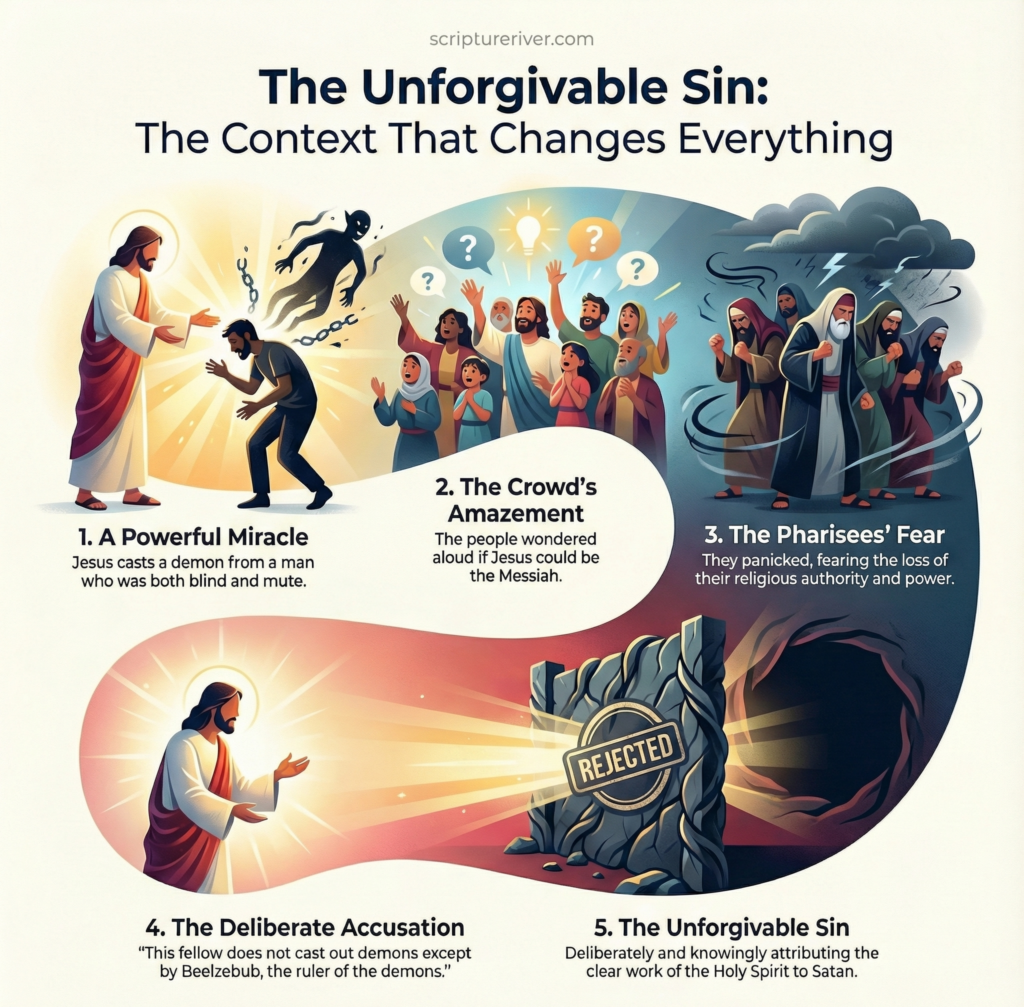
The Pharisees had just watched Jesus cast out a demon from a man who was blind and mute.
The crowd was amazed. They asked, “Could this be the Son of David?” They were recognizing Jesus might be the Messiah.
The Pharisees panicked. If people believed Jesus was the Messiah, the Pharisees would lose their religious authority and power.
So they offered an alternate explanation for Jesus’s power.
Matthew 12:24, New King James Version (NKJV)
“But when the Pharisees heard it they said, ‘This fellow does not cast out demons except by Beelzebub, the ruler of the demons.'”
They attributed Jesus’s obvious work of the Holy Spirit to Satan.
They saw God’s power operating through Jesus. They knew it was supernatural. They recognized it was real. But instead of acknowledging it was from God, they called it demonic.
That’s the context for Jesus’s warning about the unforgivable sin.
He wasn’t talking about cursing, doubting, or even rejecting Him temporarily.
He was addressing people who were deliberately, knowingly, persistently attributing the Holy Spirit’s clear work to Satan.
What Blasphemy Against the Holy Spirit Actually Is
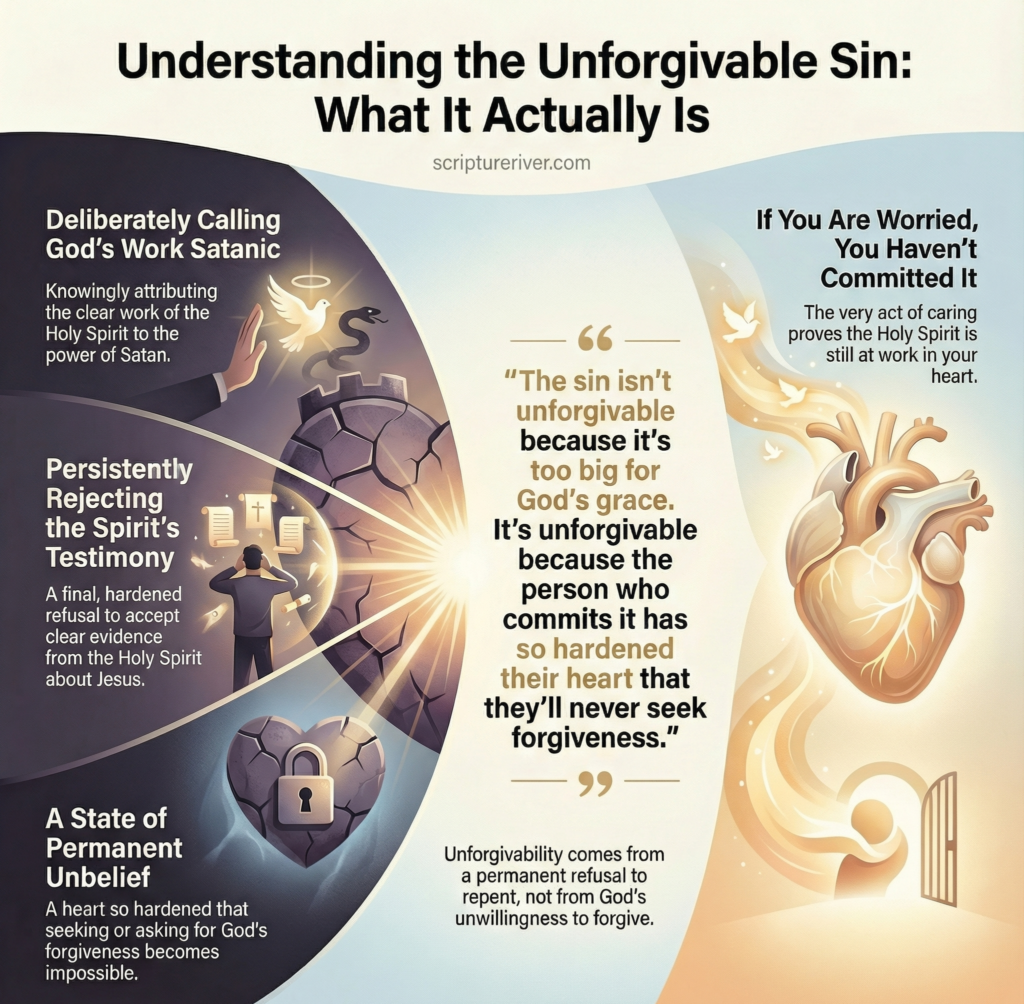
Based on the biblical context, here’s what the unforgivable sin actually involves.
1. It’s Deliberate Attribution of God’s Work to Satan
The Pharisees weren’t ignorant or confused.
They were educated religious leaders who knew Scripture intimately. They recognized Jesus was doing things only God could do.
But they had a choice: acknowledge Jesus as Messiah and lose their power, or reject Jesus and maintain their authority.
They chose the latter. Consciously. Deliberately. Knowing what they were doing.
They saw the Holy Spirit’s work and called it Satan’s work. Not out of ignorance. Out of willful, persistent rejection of truth they clearly recognized.
That’s blasphemy against the Holy Spirit.
2. It’s Persistent Rejection of the Spirit’s Testimony About Jesus
The Holy Spirit’s primary work is testifying about Jesus and convicting people of sin, righteousness, and judgment.
John 15:26 says the Spirit testifies about Jesus. John 16:8-11 says He convicts the world of sin because they don’t believe in Jesus.
Blasphemy against the Holy Spirit means persistently, finally, and completely rejecting the Spirit’s testimony about who Jesus is despite clear evidence.
It’s not momentary doubt. It’s not struggling with faith. It’s a hardened, permanent rejection of Jesus despite knowing He’s real and seeing proof of His deity.
3. It’s a State of Permanent Unbelief
The reason this sin is unforgivable isn’t because God refuses to forgive it.
It’s because the person who commits it has reached a state of permanent, hardened unbelief where repentance is impossible.
Hebrews 6:4-6 describes people who’ve been enlightened, tasted the heavenly gift, shared in the Holy Spirit, and then fallen away.
It’s impossible to restore them to repentance because they’re crucifying the Son of God all over again.
The sin isn’t unforgivable because it’s too big for God’s grace.
It’s unforgivable because the person who commits it has so hardened their heart that they’ll never seek forgiveness.
You can’t be forgiven if you never repent. Not because God won’t forgive. Because you won’t ask.
Why You Haven’t Committed This Sin
If you’re reading this worried you’ve blasphemed the Holy Spirit, you haven’t. Here’s why.
You’re Concerned About Your Spiritual State
The Pharisees weren’t worried about offending God. They were worried about protecting their power.
If you’re genuinely concerned you might have committed the unforgivable sin, that concern itself proves you haven’t.
People who’ve truly blasphemed the Holy Spirit don’t care. Their hearts are so hardened that they feel no conviction.
Your fear of having done it demonstrates the Holy Spirit is still working in your life, convicting you, drawing you to God.
That’s the opposite of blasphemy against the Spirit.
You Want to Be Right With God
Blasphemy against the Holy Spirit involves permanent rejection of God’s offer of salvation through Jesus.
If you want to be reconciled to God, you haven’t permanently rejected Him.
If you’re seeking forgiveness, you haven’t committed a sin that makes repentance impossible.
The very desire to be forgiven proves you’re capable of repentance, which proves you haven’t committed the unforgivable sin.
You Haven’t Attributed Jesus’s Clear Work to Satan
Have you knowingly, deliberately watched Jesus perform an obvious miracle through the Holy Spirit’s power and then called it demonic?
No. You haven’t seen Jesus in person performing miracles.
The Pharisees’ sin was specific to their historical situation: seeing Jesus in person, watching Him do what only God could do, and then deliberately attributing it to Satan to protect their own interests.
You haven’t been in that situation. So you haven’t committed that sin.
Common Fears That Aren’t the Unforgivable Sin
Let me address specific situations that terrify believers unnecessarily.
Cursing at God in Anger
Saying something terrible to God in a moment of pain or anger isn’t blasphemy against the Holy Spirit.
David said incredibly harsh things to God in Psalms. Job questioned God’s justice. Both remained in a relationship with God.
Angry words spoken in suffering aren’t the same as hardened, permanent rejection of the Holy Spirit’s testimony about Jesus.
Doubting Your Faith
Seasons of doubt aren’t blasphemy against the Holy Spirit.
John the Baptist doubted from prison whether Jesus was actually the Messiah. Jesus didn’t condemn him. He sent reassurance.
Thomas doubted the resurrection. Jesus appeared to him personally and invited him to believe.
Doubt that seeks answers is different from hardened rejection that refuses truth.
Rejecting God During a Period of Rebellion
Walking away from God temporarily isn’t the same as permanently blaspheming the Holy Spirit.
Peter denied Jesus three times. He was restored. The prodigal son rejected his father and left. He returned and was welcomed.
Temporary rejection followed by repentance isn’t permanent blasphemy. It’s a normal spiritual struggle followed by restoration.
Having Blasphemous Thoughts You Don’t Want
Intrusive thoughts aren’t sins you’ve chosen.
Many believers experience unwanted blasphemous thoughts that horrify them.
These are often spiritual attacks or symptoms of anxiety disorders, not willful sins.
You’re responsible for the thoughts you entertain and act on.
You’re not responsible for thoughts that pop into your head uninvited and that you immediately reject.
Not Feeling God’s Presence
Spiritual dryness isn’t evidence that you’ve committed the unforgivable sin.
Every mature believer experiences seasons when God feels distant.
That’s normal Christian experience, not evidence of damnation.
God’s presence isn’t dependent on your feelings. His promises don’t change based on whether you feel close to Him or not.
The Real Danger That Christians Should Worry About
The unforgivable sin isn’t the danger most Christians face.
The real danger is gradual hardening through persistent, unrepentant sin.
Hebrews 3:12-13 warns about developing “a sinful, unbelieving heart that turns away from the living God” through the deceitfulness of sin.
Sin hardens hearts progressively.
This is what I mean…
What shocks your conscience today won’t shock it tomorrow if you keep doing it.
Over time, persistent sin creates callousness that makes repentance harder and harder.
That’s the trajectory that leads toward the unforgivable sin. Not one dramatic moment of blasphemy.
Gradual hardening through years of rejecting the Spirit’s conviction until you reach a point where you no longer care.
The way to avoid that trajectory isn’t obsessing over whether you’ve committed the unforgivable sin.
It’s responding immediately to the Holy Spirit’s conviction when it comes.
When the Spirit convicts you of sin, repent quickly. Don’t ignore it. Don’t rationalize it. Don’t put it off. Respond.
That keeps your heart soft and responsive to God, which is the opposite direction from blasphemy against the Spirit.
What to Do If You’re Still Worried
Despite everything I’ve said, some people reading this are still terrified they’ve committed the unforgivable sin.
Here’s what to do with that fear.
First, pray this prayer:
Father, I’m terrified I’ve committed the unforgivable sin. I’m afraid I’ve crossed a line I can’t uncross. I want to be right with You. I don’t want to be separated from You forever. If there’s any sin in my life, I repent of it right now. I want Jesus as my Savior and Lord. Please forgive me and restore me to relationship with You. In Jesus’s Name, Amen.
If you prayed that sincerely, you haven’t committed the unforgivable sin.
People who’ve truly blasphemed the Holy Spirit wouldn’t pray that prayer because they don’t want restoration with God.
Second, talk to a trusted pastor or Christian counselor.
Persistent fear that you’ve committed the unforgivable sin despite biblical evidence to the contrary might be a spiritual attack, religious OCD, or anxiety that requires professional help.
There’s no shame in seeking help. God uses counselors and pastors to minister truth and healing to struggling believers.
Third, immerse yourself in Scripture’s promises of forgiveness.
1 John 1:9 promises that if we confess our sins, God is faithful to forgive and cleanse us from all unrighteousness.
Romans 8:1 declares there’s no condemnation for those in Christ Jesus.
Psalm 103:12 says God removes our sins as far as the east is from the west.
Read these promises daily. Let truth replace fear.
The Gospel Truth That Settles This
Here’s what settles the question of the unforgivable sin for believers.
Jesus died for all sins. 1 John 2:2 says He’s the atoning sacrifice for the sins of the whole world.
The only sin that can’t be forgiven is the sin of final, permanent rejection of Jesus that makes repentance impossible.
If you want Jesus, you haven’t permanently rejected Him. If you can repent, you haven’t committed unforgivable sin.
That young woman who sat in my office crying? I told her the same thing I’m telling you.
Your fear proves you haven’t done it.
Your desire for forgiveness proves repentance is possible.
Your concern about your relationship with God proves the Holy Spirit is still working in your life.
You haven’t blasphemed the Holy Spirit. You’re not damned. God hasn’t given up on you.
Come to Him. He’s ready to receive you.
Prayer for Those Who Fear They’ve Gone Too Far
Father, I’ve been tormented by fear that I’ve committed the unforgivable sin. I’m terrified I’ve crossed a line that makes restoration impossible.
But Your Word says if I confess my sins, You’re faithful to forgive. So I’m confessing everything I can think of. Every sin. Every failure. Every moment of rebellion. I repent of it all.
I want Jesus as my Savior. I want the Holy Spirit working in my life. I want relationship with You.
Please forgive me and give me peace that I’m forgiven. Replace this tormenting fear with confident assurance of Your love. Help me believe Your promises instead of my fears.
In Jesus’s Name, Amen.
References
Blomberg, C. L. (1992). Matthew. B&H Publishing Group. [Book]
Carson, D. A. (1984). Matthew: The Expositor’s Bible Commentary (Vol. 8). Zondervan. [Book]
Edwards, J. R. (2002). The Gospel According to Mark. Eerdmans Publishing Company. [Book]
France, R. T. (2007). The Gospel of Matthew. Eerdmans Publishing Company. [Book]
Garland, D. E. (2011). Luke. Zondervan. [Book]
Morris, L. (1992). The Gospel According to Matthew. Eerdmans Publishing Company. [Book]
Peterson, E. H. (2005). The Message: The Bible in Contemporary Language. NavPress. [Bible Translation]
Strong, J. (2010). Strong’s Exhaustive Concordance of the Bible. Hendrickson Publishers. [Reference Book]
Stott, J. R. W. (1985). The Message of the Sermon on the Mount. InterVarsity Press. [Book]
Wiersbe, W. W. (2007). The Bible Exposition Commentary: New Testament (Vol. 1). David C. Cook. [Book]

