

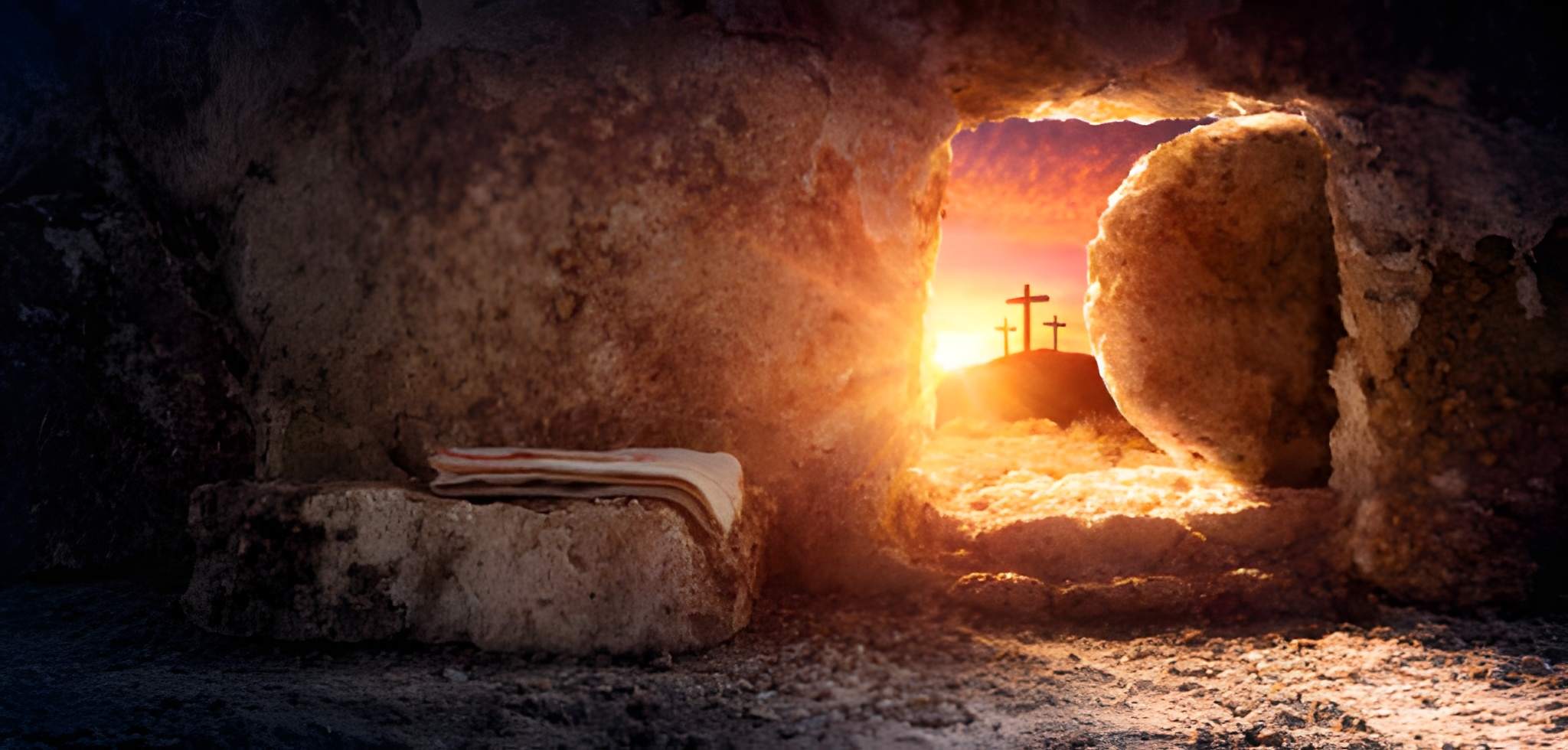
Christianity stands or falls on three words: the tomb is empty.
Every sermon you’ve heard, every prayer you’ve prayed, every hope you’ve held for eternity hinges entirely on whether Jesus’s body walked out of that Jerusalem tomb on the third day.
If it didn’t, your faith is worthless. Your sins aren’t forgiven. Death still wins.
And everyone who’s died believing in Jesus died deceived.
Paul says this explicitly in 1 Corinthians 15:17: “And if Christ has not been raised, your faith is futile and you are still in your sins.”
The empty tomb isn’t sentimental Easter imagery. It’s not metaphor for spiritual renewal or symbol of fresh starts.
It’s historical event that either happened or didn’t, with eternal consequences riding on which is true.
Most Christians know the resurrection is important.
But only few understand why the empty tomb specifically matters or what it actually proves.
A resurrected Jesus whose body stayed in the tomb would be spirit without victory over death.
An empty tomb with Jesus still dead would be grave robbery, not salvation.
The empty tomb means something precise biblically, something that transforms everything about how you live now and what you can hope for eternally.
The Historical Testimony: Multiple Witnesses
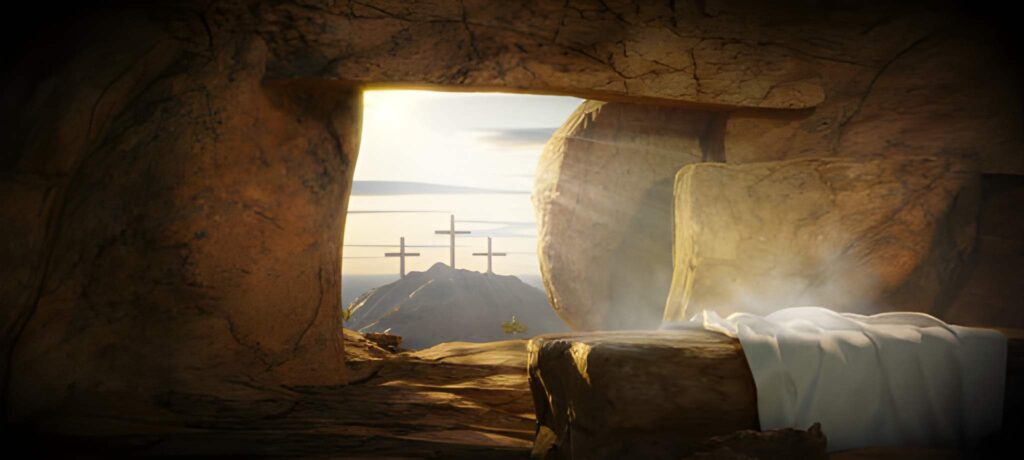
The empty tomb isn’t legend that developed centuries later. It’s testified to by multiple independent sources within decades of the event.
The Gospel Accounts
All four Gospels testify to the empty tomb, though with different details that actually strengthen rather than weaken the case.
According to New Testament scholar Craig Blomberg’s research on Gospel reliability, the variations in details while maintaining core agreement on the empty tomb indicate independent testimony rather than collusion.
Mark 16:6, English Standard Version (ESV)
“And he said to them, ‘Do not be alarmed. You seek Jesus of Nazareth, who was crucified. He has risen; he is not here. See the place where they laid him.'”
Matthew 28:6, Christian Standard Bible (CSB)
“He is not here. For he has risen, just as he said. Come and see the place where he lay.”
Luke 24:3, New International Version (NIV)
“But when they entered, they did not find the body of the Lord Jesus.”
John 20:6-7, New King James Version (NKJV)
“Then Simon Peter came, following him, and went into the tomb; and he saw the linen cloths lying there, and the handkerchief that had been around His head, not lying with the linen cloths, but folded together in a place by itself.”
Why Women’s Testimony Matters
All four Gospels agree women were the first witnesses to the empty tomb.
In first-century Jewish culture, women’s testimony wasn’t considered legally valid in courts.
According to historian Richard Bauckham’s research on eyewitness testimony in the Gospels, if the church fabricated the resurrection story, they would never have made women the primary witnesses.
The fact that they’re consistently recorded as first witnesses despite the cultural embarrassment this would cause strongly suggests historical accuracy rather than invention.
The Jewish Response Confirms the Tomb Was Empty
Matthew 28:11-15 records that Jewish authorities bribed guards to claim disciples stole the body. This response is crucial. They didn’t deny the tomb was empty. They provided alternative explanation for why it was empty.
If the tomb still contained Jesus’s body, the Jewish authorities would simply have produced it and ended Christianity immediately. Their response acknowledges the empty tomb while disputing its meaning.
What the Empty Tomb Proves
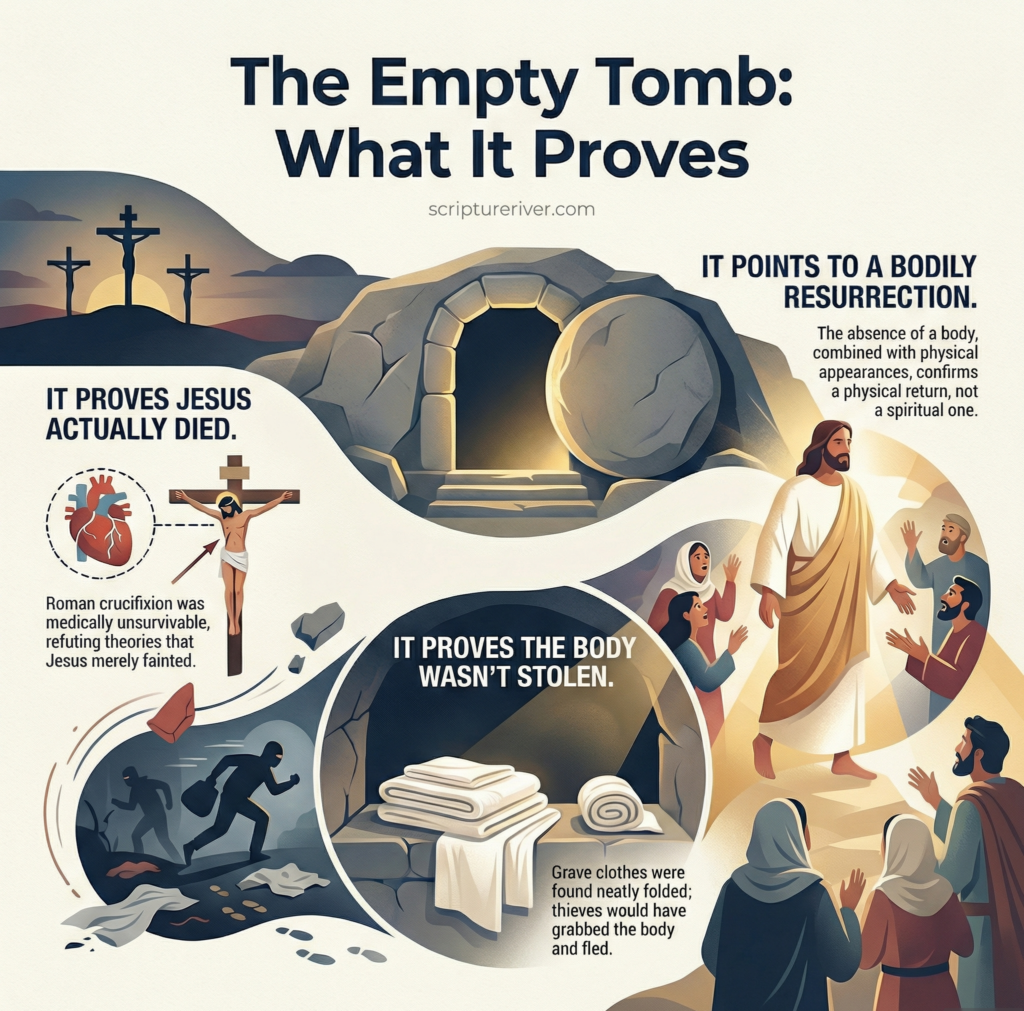
The empty tomb by itself doesn’t prove resurrection.
But it eliminates every alternative explanation and points compellingly toward bodily resurrection.
1. It Proves Jesus Actually Died
Some theories suggest Jesus didn’t die but merely swooned on the cross and revived in the tomb’s cool air. The empty tomb combined with Roman execution methods makes this impossible.
Roman crucifixion was designed to guarantee death.
According to medical analysis published by physician William Edwards in the Journal of the American Medical Association, the combination of scourging, blood loss, shock, and asphyxiation from crucifixion made survival medically impossible.
The spear thrust confirming death (John 19:34) released “blood and water,” indicating cardiac rupture and death.
A barely-alive Jesus couldn’t have unwrapped grave clothes, moved a sealed stone, overcome guards, walked miles on pierced feet, and convinced disciples He’d conquered death.
2. It Proves the Body Wasn’t Stolen
The grave clothes remaining in the tomb (John 20:6-7) eliminate theft theories. Thieves don’t unwrap bodies and fold burial cloths neatly. They grab the body and run.
The position of the grave clothes, according to archaeological expert Jodi Magness’s research on Jewish burial practices, suggests the body passed through them, leaving them collapsed where they’d been wrapped around Jesus.
3. It Points to Bodily Resurrection
The empty tomb combined with resurrection appearances (Jesus eating fish in Luke 24:42-43, inviting Thomas to touch wounds in John 20:27, cooking breakfast in John 21:9-13) demonstrates physical resurrection, not spiritual.
Greek philosophy believed in immortality of the soul but found bodily resurrection repugnant.
According to New Testament scholar N.T. Wright’s extensive research on resurrection belief, first-century Jews distinguished between resuscitation (coming back to same mortal body) and resurrection (receiving glorified immortal body).
Jesus’s resurrection was the latter.
The empty tomb proves His resurrection wasn’t spiritual apparition but physical transformation into glorified body that will never die again.
The Theological Meaning: What the Empty Tomb Accomplishes
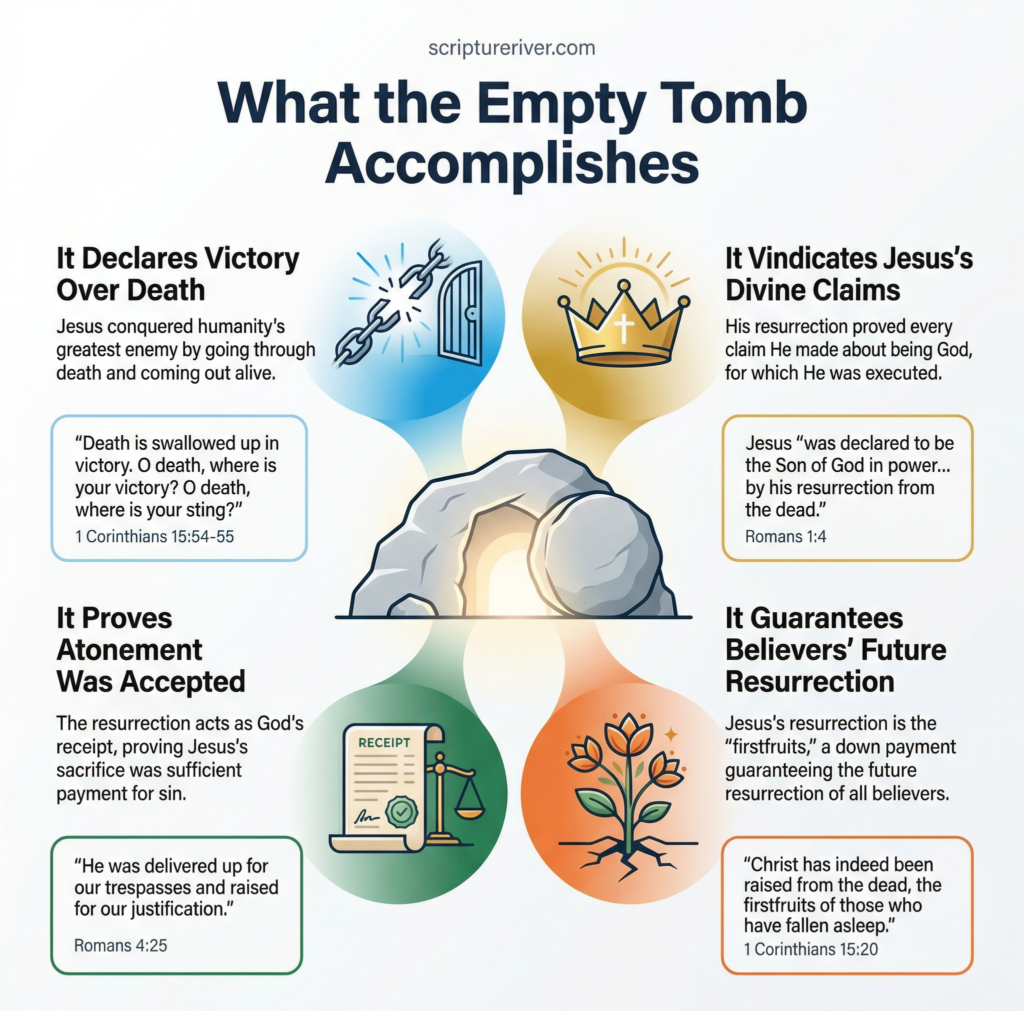
The empty tomb isn’t just historical curiosity. It accomplishes specific theological realities that define Christianity.
1. Victory Over Death
1 Corinthians 15:54-55, English Standard Version (ESV)
“Death is swallowed up in victory. O death, where is your victory? O death, where is your sting?”
The empty tomb means death lost. Not temporarily. Permanently. Jesus didn’t escape death by avoiding it. He conquered it by going through it and coming out the other side alive.
According to theologian Wolfhart Pannenberg’s research on resurrection theology, Jesus’s resurrection demonstrated that death has no permanent power over those united to Christ.
The empty tomb is evidence that the enemy humanity feared most has been defeated.
2. Vindication of Jesus’s Claims
Jesus claimed to be God (John 8:58, John 10:30). He predicted His resurrection (Mark 8:31, John 2:19-21). Jewish authorities condemned Him as blasphemer. Roman authorities executed Him as criminal.
The resurrection vindicated every claim He made.
According to Romans 1:4, Jesus “was declared to be the Son of God in power according to the Spirit of holiness by his resurrection from the dead.”
3. Proof That Atonement Was Accepted
Jesus’s death paid for sin. But how do we know God accepted the payment? The resurrection is receipt proving transaction completed.
Romans 4:25, Christian Standard Bible (CSB)
“He was delivered up for our trespasses and raised for our justification.”
The empty tomb demonstrates God accepted Jesus’s sacrifice as sufficient payment for sin. If Jesus remained dead, the payment was insufficient. The resurrection proves otherwise.
4. Guarantee of Future Resurrection for Believers
1 Corinthians 15:20, New International Version (NIV)
“But Christ has indeed been raised from the dead, the firstfruits of those who have fallen asleep.”
Jesus’s resurrection is “firstfruits,” meaning first installment guaranteeing more to follow. His empty tomb guarantees believers’ future resurrection.
According to systematic theologian Wayne Grudem’s work on resurrection, Christ’s resurrection in a glorified body provides the pattern and power for believers’ resurrection at His return (Philippians 3:20-21).
What The Empty Tomb Teaches Christians Today
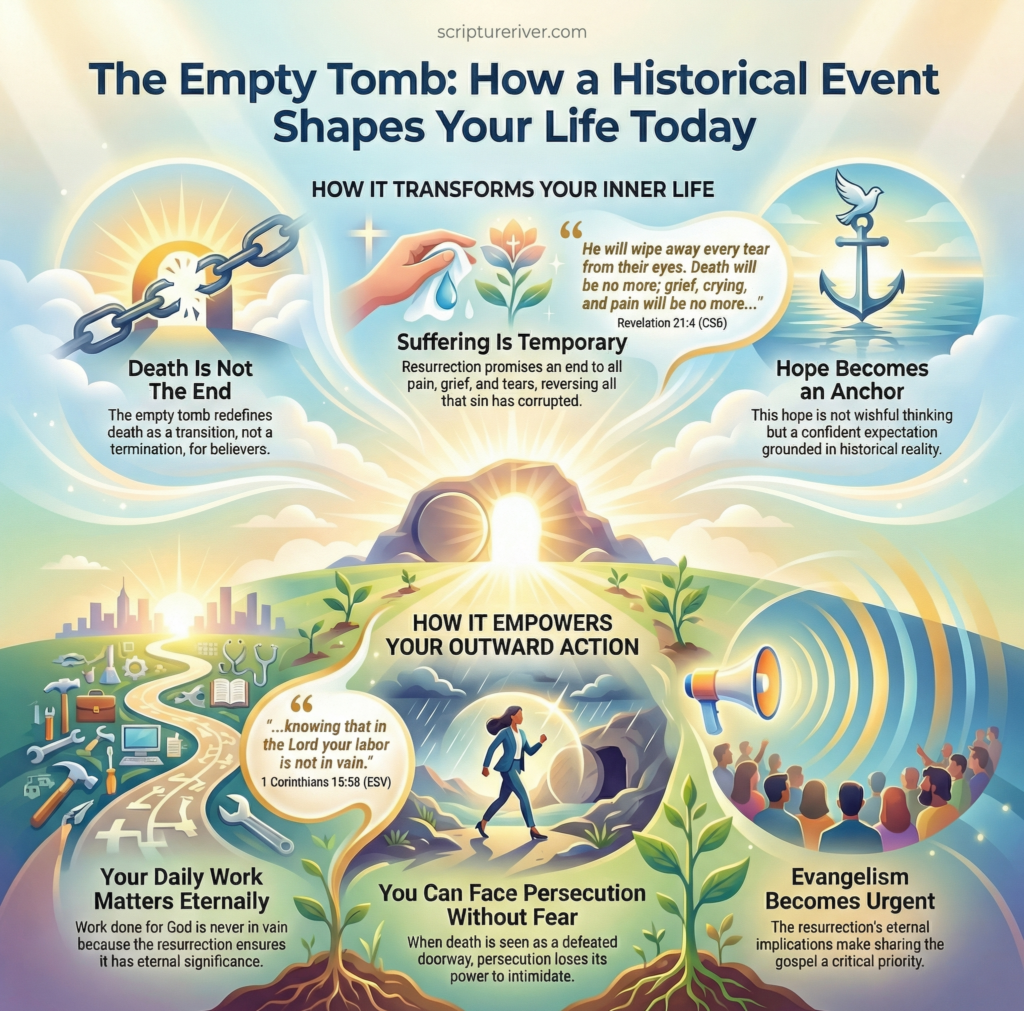
The empty tomb isn’t just ancient history. It speaks directly to how Christians should live now.
1. Death Is Not the End
The empty tomb means death is transition, not termination. Every funeral you attend for a believer is “see you later,” not “goodbye forever.”
John 11:25-26, English Standard Version (ESV)
“Jesus said to her, ‘I am the resurrection and the life. Whoever believes in me, though he die, yet shall he live, and everyone who lives and believes in me shall never die. Do you believe this?'”
When you stand at gravesides mourning loss, the empty tomb whispers that graves don’t get final word. Jesus walked out of His tomb. Believers will walk out of theirs.
2. Your Body Matters
Greek philosophy viewed bodies as prisons for souls. The empty tomb says bodies matter so much that Jesus took His with Him into eternity in glorified form.
This means how you treat your body matters. What you do with your sexuality matters. Caring for your physical health matters.
Bodies aren’t disposable shells but essential parts of who you are that God will resurrect and transform.
3. Suffering Is Temporary
The empty tomb means every tear you cry, every pain you endure, every loss you suffer is temporary. Resurrection reverses everything sin corrupted.
Revelation 21:4, Christian Standard Bible (CSB)
“He will wipe away every tear from their eyes. Death will be no more; grief, crying, and pain will be no more, because the previous things have passed away.”
When suffering feels permanent, the empty tomb testifies that resurrection is coming. What feels endless has an end date.
4. Evil Will Not Triumph
The empty tomb demonstrates that the darkest evil humanity could do (murdering God incarnate) was reversed and transformed into salvation.
If God can resurrect Jesus from that, He can redeem anything.
Every injustice you witness, every evil that seems unstoppable, every darkness that appears to be winning will ultimately be defeated.
The empty tomb proves nothing is beyond God’s power to reverse and redeem.
5. Your Work Matters Eternally
1 Corinthians 15:58, English Standard Version (ESV)
“Therefore, my beloved brothers, be steadfast, immovable, always abounding in the work of the Lord, knowing that in the Lord your labor is not in vain.”
This verse follows Paul’s lengthy resurrection teaching. The empty tomb means work done for God’s kingdom isn’t wasted. Resurrection reality transforms how you view daily labor.
The parent changing diapers for God’s glory, the employee working with integrity, the volunteer serving without recognition, all labor done in Christ connects to resurrection reality that will endure eternally.
6. You Can Face Persecution Without Fear
Early Christians went to their deaths singing. Martyrs throughout history have faced execution with peace. The empty tomb explains how.
When you know death is defeated doorway, not dead end, persecution loses its power to intimidate. According to church historian Eusebius’s records of early martyrs, believers’ fearlessness in face of death was primary apologetic convincing pagans Christianity was true.
7. Evangelism Becomes Urgent
If the empty tomb is real, people without Christ face eternity separated from God. This makes sharing the gospel critically urgent.
The resurrection isn’t spiritual metaphor. It’s historical event with eternal implications. People need to hear that death’s defeat is available through faith in the risen Christ.
8. Hope Anchors Your Soul
Hebrews 6:19, New International Version (NIV)
“We have this hope as an anchor for the soul, firm and secure. It enters the inner sanctuary behind the curtain.”
Hope isn’t wishful thinking. It is confident expectation grounded in the empty tomb’s historical reality.
When life falls apart, resurrection hope anchors your soul to eternal realities that circumstances can’t touch.
Frequently Asked Questions
What if the disciples hallucinated seeing Jesus?
Hallucinations don’t explain the empty tomb. Even if disciples hallucinated resurrection appearances, the body would still be in the tomb. The Jewish authorities would have produced it. Additionally, hallucinations are individual experiences. Over 500 people claimed to see the risen Jesus at once (1 Corinthians 15:6). Mass hallucinations aren’t medically or psychologically credible.
Could someone have moved the body?
Roman guards secured the tomb (Matthew 27:65-66). Moving the body would require overpowering trained soldiers. The grave clothes left behind eliminate theft. No one who moved a body would unwrap it first. Most compelling: who would move it? Disciples were hiding in fear. Authorities wanted the body to stay put to prevent resurrection claims.
Why does the resurrection body matter if we’re going to heaven anyway?
Heaven isn’t final destination. Resurrection to new earth is (Revelation 21:1-4). The empty tomb teaches bodies are essential to who we are. Disembodied existence isn’t God’s plan. Embodied existence in glorified, imperishable bodies is. This is why the empty tomb matters so profoundly.
If resurrection is guaranteed, why do Christians still fear death?
Fear of death process is natural. Even Jesus experienced distress about His approaching death (Luke 22:44). But resurrection hope transforms that fear from paralyzing dread to manageable anxiety. The empty tomb doesn’t eliminate all death fear, but it removes death’s ultimate power to destroy us.
How should the empty tomb change my daily life?
It should make you bolder in faith, more generous in service, less anxious about outcomes, more hopeful in suffering, and more urgent about sharing the gospel. When resurrection is real, present circumstances lose their absolute power over you. You can risk more, sacrifice more, and endure more when you know resurrection reverses everything.
What about people who never heard about the empty tomb?
Scripture teaches that God judges fairly based on light people received (Romans 2:12-16). However, the empty tomb demonstrates that God provided specific historical revelation through Christ’s resurrection. Christians have responsibility to share this news so people can hear, believe, and be saved (Romans 10:13-15).
Cited Sources
Bauckham, R. (2006). Jesus and the Eyewitnesses: The Gospels as Eyewitness Testimony. Eerdmans Publishing Company. [Historical Study]
Blomberg, C. L. (2007). The Historical Reliability of the Gospels (2nd ed.). InterVarsity Press. [New Testament Scholarship]
Edwards, W. D., Gabel, W. J., & Hosmer, F. E. (1986). “On the Physical Death of Jesus Christ.” Journal of the American Medical Association, 255(11), 1455-1463. [Medical Research]
Grudem, W. (1994). Systematic Theology: An Introduction to Biblical Doctrine. Zondervan. [Systematic Theology]
Magness, J. (2011). Stone and Dung, Oil and Spit: Jewish Daily Life in the Time of Jesus. Eerdmans Publishing Company. [Archaeological Study]
Pannenberg, W. (1968). Jesus—God and Man. Westminster Press. [Resurrection Theology]
Peterson, E. H. (2005). The Message: The Bible in Contemporary Language. NavPress. [Bible Translation]
Strong, J. (2010). Strong’s Exhaustive Concordance of the Bible. Hendrickson Publishers. [Reference Book]
Wright, N. T. (2003). The Resurrection of the Son of God. Fortress Press. [New Testament Theology]

