

I was the most spiritually mature person in the room.
Or so I thought.
I’d been leading Bible studies for years. I prayed eloquently in public.
People came to me for spiritual advice.
I knew Scripture well and could defend my theology against any challenge.
Then I watched myself correct a new believer’s prayer during a small group meeting.
She’d used theologically imprecise language, and I couldn’t let it slide.
I interrupted her mid-sentence to offer the “proper” way to pray.
The room went silent. She looked mortified.
And the Holy Spirit whispered what I’d refused to see: my confidence in my spiritual knowledge had rotted into pride.
That moment exposed the dangerous truth every maturing Christian faces.
There’s a razor-thin line between healthy confidence in what God has given you and toxic pride that makes you think you’re better than others because of it.
Proverbs 16:18 warns exactly where that line gets crossed and what happens when you cross it.
Understanding Solomon’s Warning About Pride
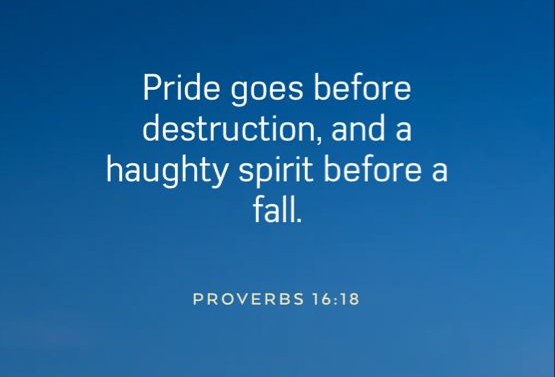
Here’s the verse most people can quote, but fewer people understand:
Proverbs 16:18, New International Version (NIV)
“Pride goes before destruction, a haughty spirit before a fall.”
This isn’t a suggestion. It’s a pattern Solomon observed repeatedly.
Pride doesn’t sometimes lead to destruction. It reliably, predictably leads to destruction.
The Hebrew word for pride is “ga’own,” which means arrogance, presumption, exaltation of self.
It’s the attitude that says, “I’m sufficient without God” or “I’m superior to others.”
The word for destruction is “sheber,” meaning breaking, fracture, or collapse.
Not a minor inconvenience. Actual ruin.
Solomon is saying: If you’re operating in pride, your fall is coming. Not maybe. Inevitably.
The Difference Between Confidence and Pride
This is where it gets tricky.
Scripture commands certain kinds of confidence while condemning pride.
How do you know which one you’re operating in?
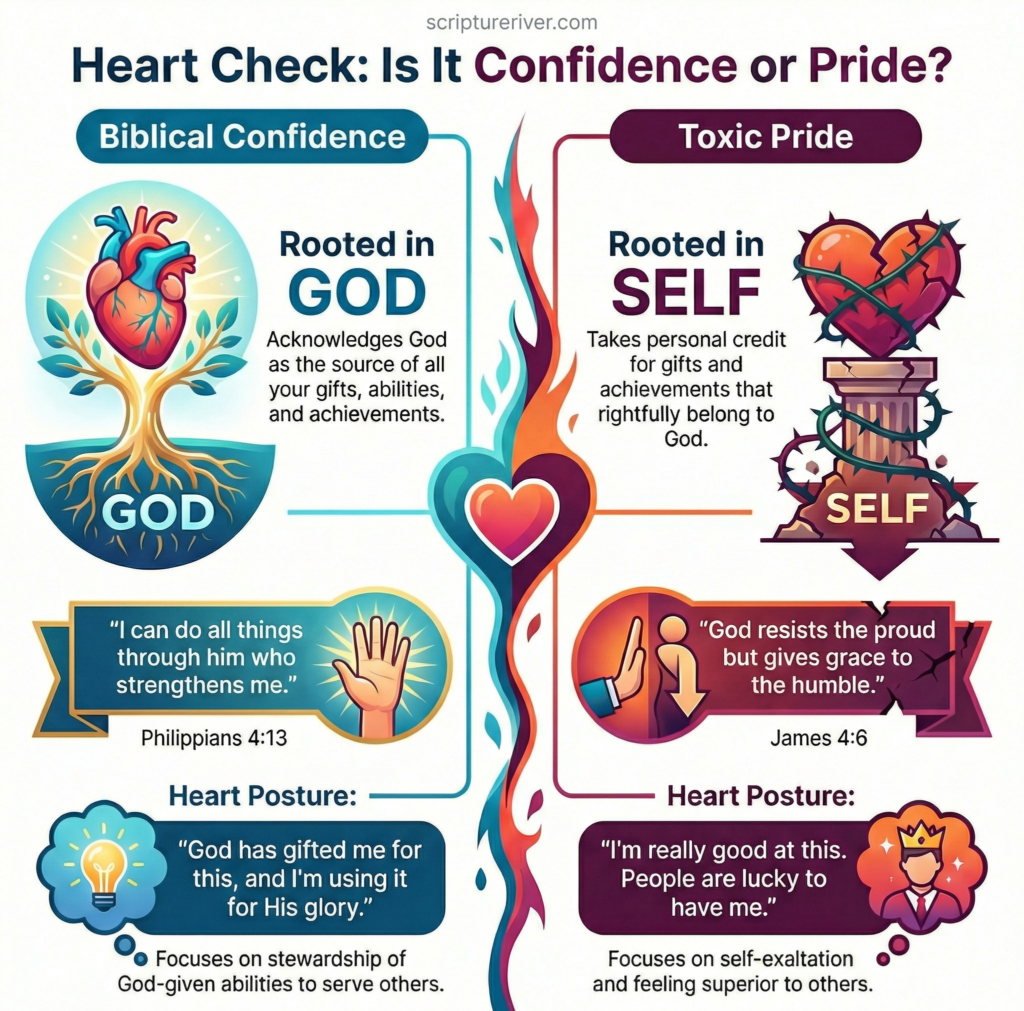
Biblical Confidence: Rooted in God
Healthy confidence acknowledges God as the source of everything you have and can do.
Philippians 4:13, English Standard Version (ESV) models this:
“I can do all things through him who strengthens me.”
Paul was confident. He’d accomplished remarkable things in ministry.
Yet he attributed his ability to Christ’s strength, not his own greatness.
That’s biblical confidence. Knowing what God has equipped you to do while remembering He’s the one who equipped you.
When I lead Bible studies effectively, biblical confidence says, “God has gifted me for this. I’m using what He gave me for His glory.”
Pride says: “I’m really good at this. People are lucky to have me as their teacher.”
See the difference? Same activity. Completely different heart posture.
Pride: Rooted in Self
Pride takes credit that belongs to God.
It looks at gifts, abilities, knowledge, or achievements and says, “I did this” rather than “God did this through me.”
James 4:6, Christian Standard Bible (CSB) explains God’s response to pride:
“But he gives greater grace. Therefore he says: God resists the proud but gives grace to the humble.”
God doesn’t just withhold blessings from the proud.
He actively opposes them. That’s a terrifying reality most Christians don’t take seriously enough.
When I corrected that new believer’s prayer, I was operating in pride.
I’d taken my years of biblical study (a gift from God) and used it to elevate myself above her rather than serve her growth.
7 Signs Confidence Has Become Pride
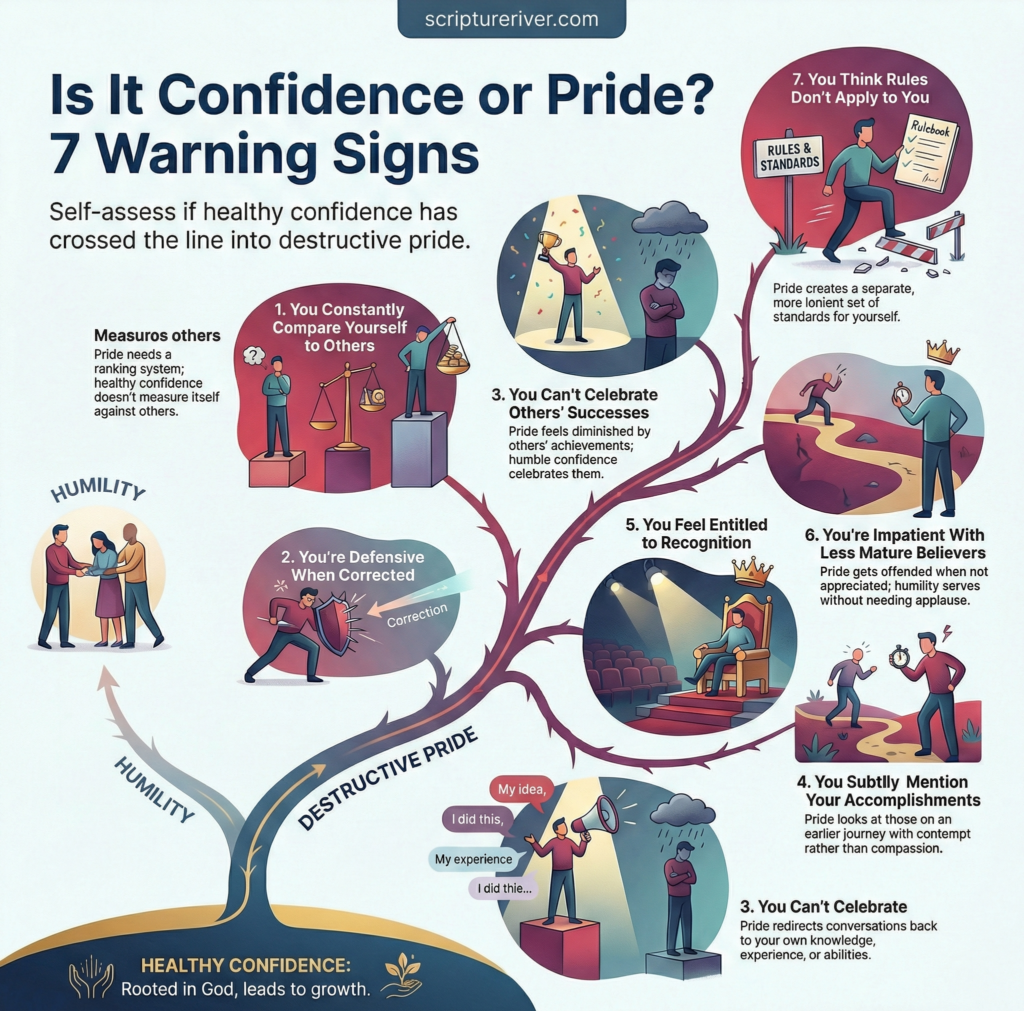
Pride is sneaky. It disguises itself as virtue. Here’s how to recognize when your confidence has crossed into pride territory.
1. You Compare Yourself to Others Constantly
Pride requires an audience and a ranking system.
Healthy confidence doesn’t need to measure itself against others.
Pride constantly evaluates: am I more spiritual, more knowledgeable, more successful, more anything than the people around me?
Galatians 6:4, New King James Version (NKJV) addresses this:
“But let each one examine his own work, and then he will have rejoicing in himself alone, and not in another.”
If your confidence depends on being better than someone else, it’s pride.
2. You’re Defensive When Corrected
Pride can’t accept correction without feeling threatened.
When someone points out an error, pride’s immediate response is to defend, justify, or counterattack.
Humble confidence receives correction gratefully, knowing it helps you grow.
Proverbs 12:1 says whoever loves discipline loves knowledge, but whoever hates correction is stupid. Harsh words, but accurate. Pride makes you unteachable, which makes you foolish.
3. You Can’t Celebrate Others’ Successes
When someone else succeeds in an area you consider “yours,” how do you respond?
Pride feels threatened by others’ success. It diminishes their accomplishments or finds ways to highlight their failures to make yourself feel superior.
Humble confidence celebrates others’ gifts without feeling diminished by them.
4. You Subtly Mention Your Accomplishments Often
Pride finds ways to work its resume into every conversation.
Someone mentions a ministry struggle, and you respond with how you handled a similar situation successfully.
Someone shares a spiritual insight, and you add what you learned about that topic years ago.
It’s not always obvious self-promotion.
But it’s a pattern of redirecting conversations back to your knowledge, experience, or abilities.
5. You Feel Entitled to Recognition
Pride believes you deserve acknowledgment for what you’ve done.
When your contributions aren’t noticed or appreciated, you feel offended.
When someone else gets credit for something you helped with, resentment builds.
Humble confidence serves without needing recognition because service itself is the reward.
6. You’re Impatient With Less Mature Believers
This was my downfall with that new believer’s prayer.
Pride looks at people earlier in their spiritual journey with contempt rather than compassion.
It can’t remember where they are. It’s frustrated by their lack of knowledge or maturity.
Jesus never treated spiritual immaturity with contempt.
He was endlessly patient with confused disciples, doubting followers, and people asking basic questions.
7. You Think Rules Don’t Apply to You
Pride believes it’s earned exemptions from standards others must follow.
You can gossip a little because you have wisdom to share.
You can skip church because your spiritual maturity doesn’t require corporate worship.
You can bend ethical rules because you have good intentions.
Pride creates a separate set of standards for yourself that’s more lenient than what you expect from others.
The Destruction Pride Brings
Proverbs 16:18 promises that destruction follows pride. What does that actually look like?
Relational Destruction
Pride destroys relationships systematically.
Nobody wants to be around someone who thinks they’re superior.
Pride creates distance between you and the people who could help you grow.
I lost several close friendships during my season of spiritual pride.
They didn’t end dramatically. They just faded as people quietly stopped inviting me into their lives.
Spiritual Destruction
Pride cuts you off from God’s grace.
Remember James 4:6: God opposes the proud. When you’re operating in pride, you’re operating against God’s active resistance.
That means your prayers lose power. Your ministry loses effectiveness.
Your spiritual growth stalls. Not as punishment but as a natural consequence. Pride blocks the humility required to receive from God.
Ministry Destruction
I’ve watched talented ministry leaders fall spectacularly after years of pride-driven success.
Their gifting was real. Their impact was measurable.
But unchecked pride eventually produced moral failure, financial scandal, or relational implosion that destroyed their ministry.
The pattern is so consistent it’s predictable.
Pride always leads to fall. The only question is how dramatic the fall will be and how much damage it will cause.
The Path Back to Humble Confidence
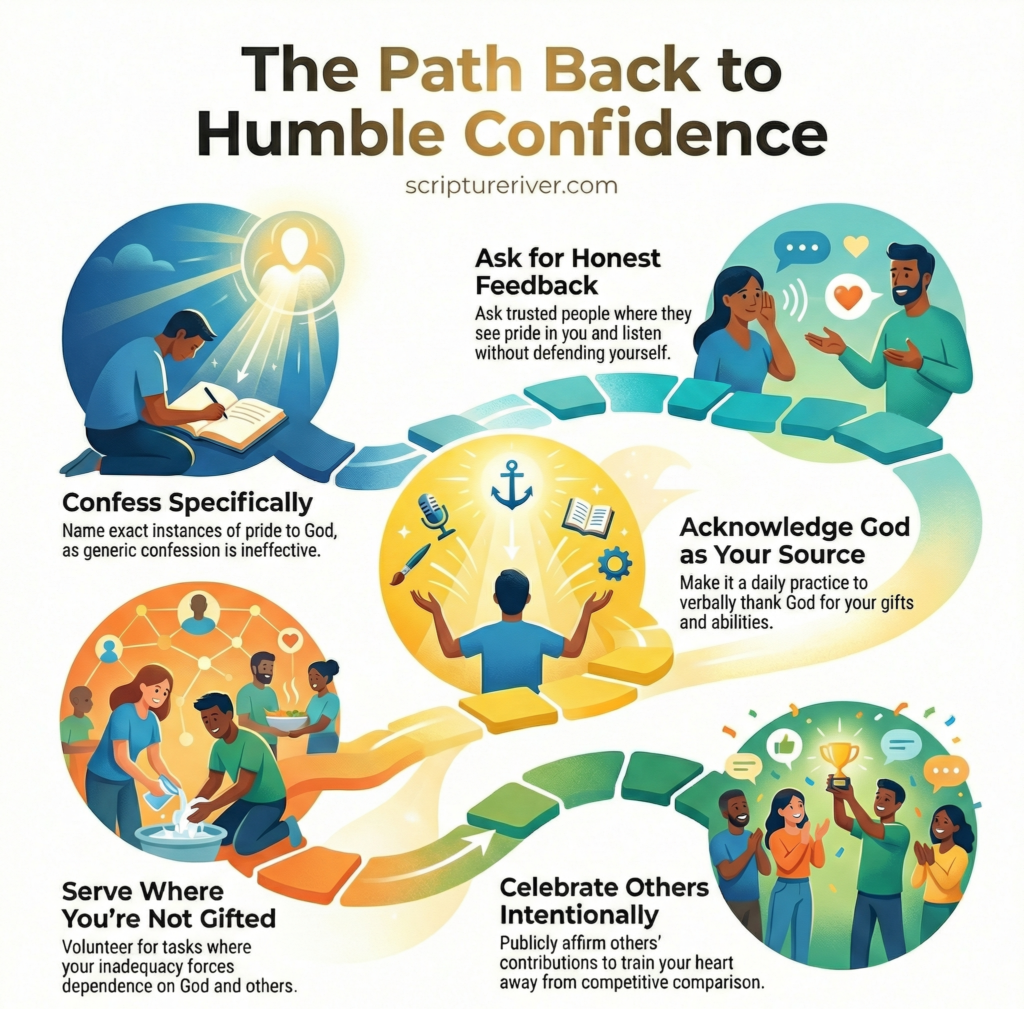
If you’re recognizing pride patterns in yourself, here’s the way back.
Confess It Specifically
Generic confession doesn’t work with pride. You have to name specific instances.
“God, I was proud when I corrected her prayer to make myself look knowledgeable rather than help her grow. I’m sorry.”
“God, I was proud when I felt resentful that he got recognition for ministry I thought I should have been credited for. Forgive me.”
Specific confession of specific pride produces specific repentance.
Ask People You Trust for Honest Feedback
This is terrifying but necessary.
Go to two or three people who know you well and love you enough to be honest. Ask them: “Do you see pride in me? Where and how?”
Then don’t defend yourself when they answer. Just listen. Thank them. Process what they said with God before responding.
Regularly Acknowledge God as Your Source
Make it a daily practice to verbally acknowledge that everything you have comes from God.
“God, this teaching ability is Your gift. This knowledge of Scripture comes from Your Spirit’s teaching. This ministry opportunity exists because You opened the door. None of it is my doing.”
That resets your perspective from pride to gratitude.
Serve in Areas Where You’re Not Gifted
Pride thrives in areas where you excel. Humility develops where you struggle.
Volunteer for the church setup team if you’re a gifted teacher.
Serve in children’s ministry if you’re an accomplished administrator.
Do tasks where your inadequacy is obvious.
That forces you to depend on God and others rather than your natural abilities.
Celebrate Others’ Gifts Intentionally
Make a practice of publicly affirming others’ contributions.
When someone teaches well, tell them specifically what you learned.
When someone serves faithfully, recognize it out loud. When someone grows spiritually, celebrate their progress.
This trains your heart away from competitive comparison toward genuine appreciation for how God works through different people.
The Freedom of Humble Confidence
Here’s what I discovered after my pride was exposed and I started walking the painful road back to humble confidence.
Humility is more freeing than pride ever was.
Pride required constant maintenance. I had to perform, compete, and prove myself continuously.
I couldn’t rest, admit weakness, or ask for help.
Humble confidence lets me know what I’m good at while admitting what I’m not.
It lets me serve with my gifts without needing applause. It lets me learn from people I used to feel superior to.
The best part? God stopped opposing me and started working through me again.
My teaching became more effective when it focused on serving others’ growth rather than showcasing my knowledge.
My relationships deepened when I stopped positioning myself above others.
My own spiritual growth accelerated when I became teachable again.
Proverbs 16:18 is a warning, yes. Pride leads to destruction inevitably.
Cross that line, and your fall is coming.
That’s not God being mean. It’s God being merciful. He exposes pride and allows falls to prevent bigger destruction down the road.
The question isn’t whether you’ll face the choice between confidence and pride.
You will, repeatedly, as you grow in gifting and maturity.
The question is whether you’ll recognize the difference and choose humility before pride forces God to humble you through destruction.
Prayer for Humble Confidence
Father, I confess I struggle with pride. I take credit for gifts You gave me. I compare myself to others and feel superior when I excel. I’m defensive when corrected.
I want recognition for my service rather than serving for Your glory alone. Forgive me. Show me where pride has taken root in my heart. Give me courage to confess it specifically and humility to receive correction.
Help me walk in confidence about what You’ve equipped me to do while remaining humble about who gets the credit. Make me teachable, grateful, and quick to celebrate others rather than compete with them.
Keep me from the destruction pride brings by exposing pride before it leads to fall. I want to be confident in You, not proud of myself.
In Jesus’s Name, Amen.
References
Bridges, J. (2007). Respectable Sins: Confronting the Sins We Tolerate. NavPress. [Book]
Keller, T. (1997). The Freedom of Self-Forgetfulness. 10Publishing. [Book]
Lewis, C. S. (1952). Mere Christianity. HarperCollins. [Book]
Mahaney, C. J. (2005). Humility: True Greatness. Multnomah Books. [Book]
Peterson, E. H. (2005). The Message: The Bible in Contemporary Language. NavPress. [Bible Translation]
Strong, J. (2010). Strong’s Exhaustive Concordance of the Bible. Hendrickson Publishers. [Reference Book]
Tozer, A. W. (1961). The Knowledge of the Holy. HarperOne. [Book]
Wiersbe, W. W. (2007). The Bible Exposition Commentary: Old Testament. David C. Cook. [Book]

