

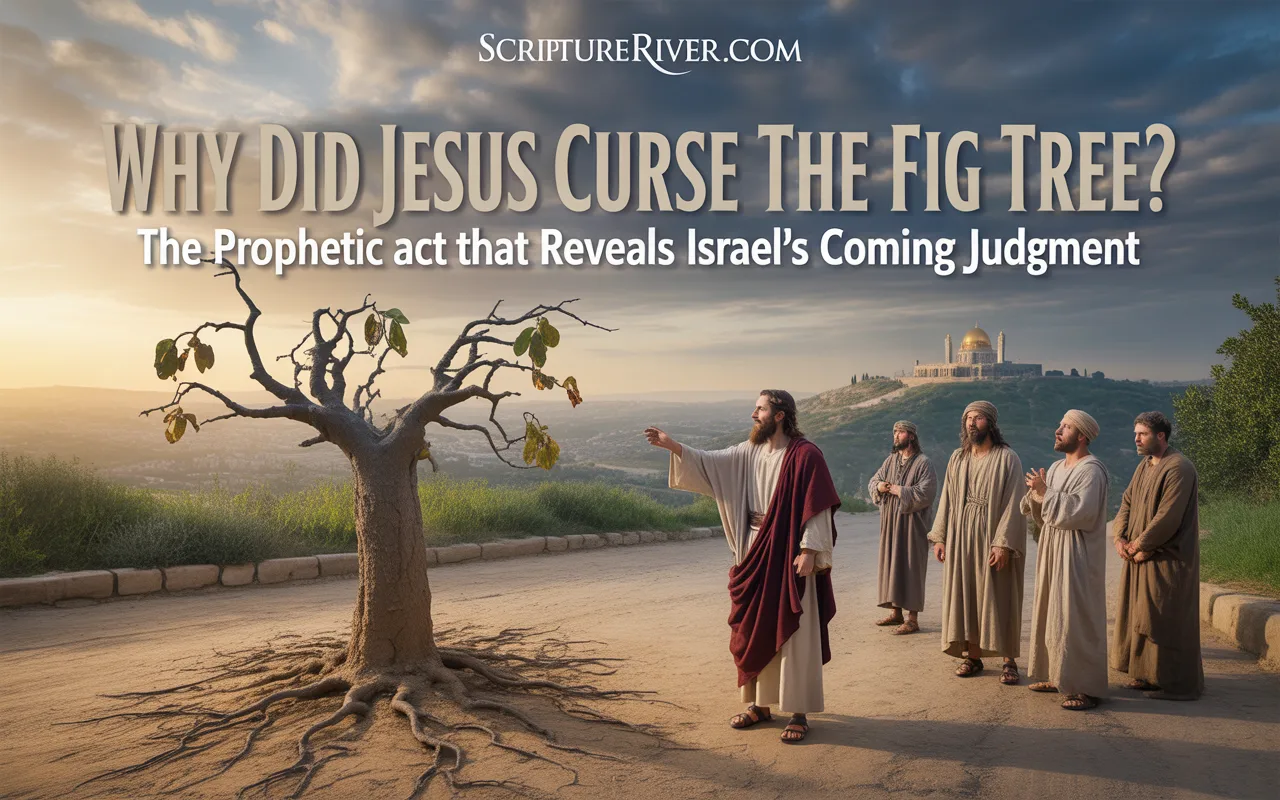
The fig tree withered from the roots up.
One moment it stood full of leaves, proudly displaying its foliage along the road from Bethany to Jerusalem.
The next morning, it was dead.
Jesus had cursed it. And His disciples were stunned.
This moment has troubled Christians for two thousand years.
Bertrand Russell used it as evidence against Christ’s divinity.
Scholars have called it “petulant” and “unworthy of Jesus.”
Even devout believers struggle with it.
Why would the compassionate Healer who welcomed children and wept over Jerusalem destroy a tree for not bearing fruit out of season?
The answer is far more profound than most Christians realize.
This wasn’t a moment of anger.
It was a prophetic act rooted in deep agricultural knowledge, ancient symbolism, and a stunning declaration about Israel’s spiritual condition.
To understand what really happened on that road, we need to journey into first-century Palestinian horticulture, explore archaeological findings about fig cultivation, and uncover biblical patterns most modern readers miss entirely.
The Biblical Account: What Actually Happened
Matthew’s Version
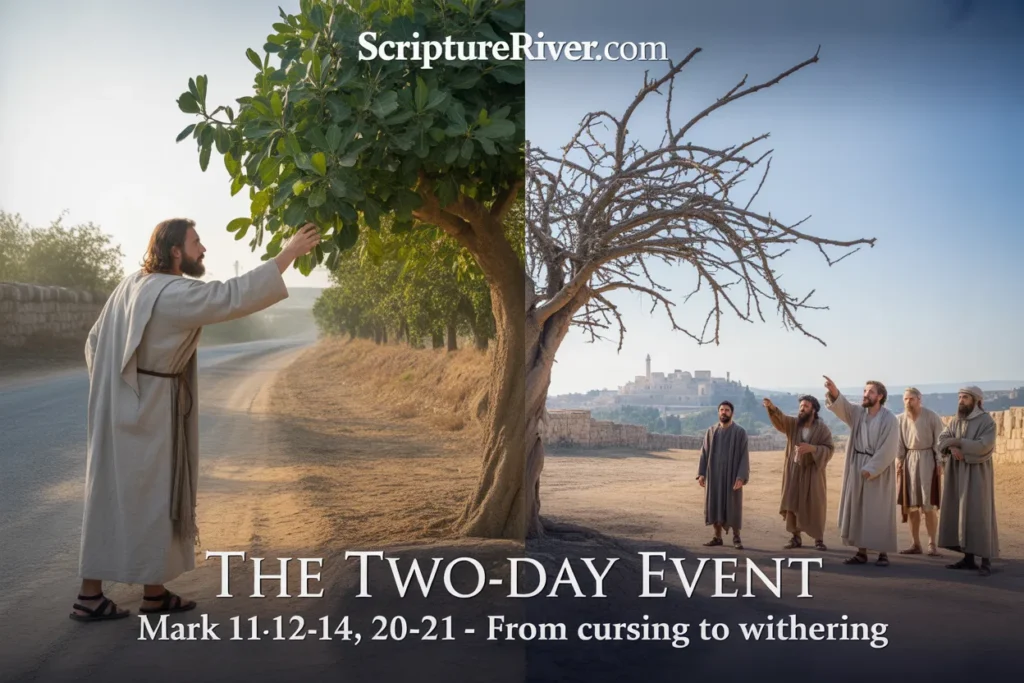
“Early in the morning, as Jesus was on his way back to the city, he was hungry. Seeing a fig tree by the road, he went up to it but found nothing on it except leaves. Then he said to it, ‘May you never bear fruit again!’ Immediately the tree withered.” Matthew 21:18-19, NIV
Mark’s More Detailed Account
“The next day as they were leaving Bethany, Jesus was hungry. Seeing in the distance a fig tree in leaf, he went to find out if it had any fruit. When he reached it, he found nothing but leaves, because it was not the season for figs. Then he said to the tree, ‘May no one ever eat fruit from you again.’ And his disciples heard him say it… In the morning, as they went along, they saw the fig tree withered from the roots. Peter remembered and said to Jesus, ‘Rabbi, look! The fig tree you cursed has withered!'” Mark 11:12-14, 20-21, NIV
The Chronological Context
Both accounts place this event during Passover week, sometime between Palm Sunday and Jesus’ crucifixion.
Jesus had entered Jerusalem triumphantly the day before.
He spent the night in Bethany with Mary, Martha, and Lazarus.
The next morning, traveling back to Jerusalem, He encountered the fig tree.
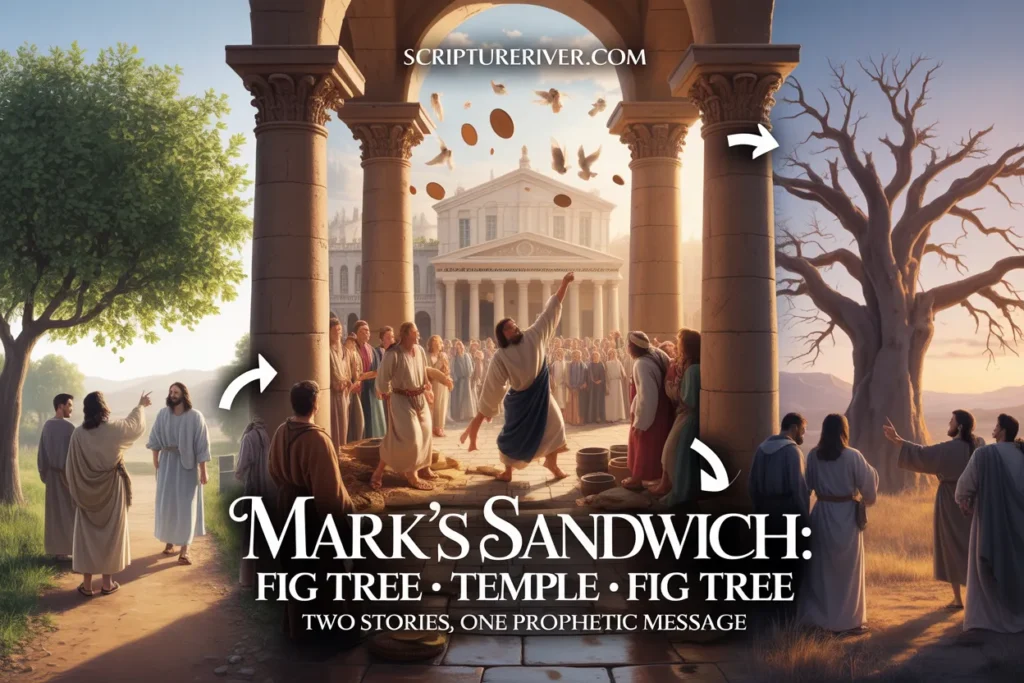
Mark’s account is particularly important because it “sandwiches” the cursing of the fig tree around the cleansing of the temple.
Jesus curses the tree, then drives out the money changers, then the disciples notice the withered tree the next morning.
This literary structure is deliberate.
Mark wants us to see these events as connected, not random.
The Agricultural Mystery Most Christians Miss
The “Out of Season” Problem
Mark explicitly states: “it was not the season for figs.”
This is where confusion begins.
Why would Jesus expect figs on a tree when figs weren’t in season?
Was He ignorant of basic horticulture?
Was He acting irrationally out of hunger?
The answer requires understanding something most modern readers have never heard of: the paggim.
First-Century Fig Tree Biology
Archaeological and botanical research reveals that Palestinian fig trees (Ficus carica) produced fruit in a complex, multi-stage process utterly foreign to modern grocery-store shoppers.
According to the Tosefta (a 2nd-century compilation of Jewish oral traditions), fig trees could yield fruit at any time during the year, not just summer.
Specific rabbinic texts mention figs appearing before the 15th of Shebat (around February), at least 45 days before Passover.
The International Standard Bible Encyclopedia documents that Palestinian fig trees produced fruit at two or even three different periods:
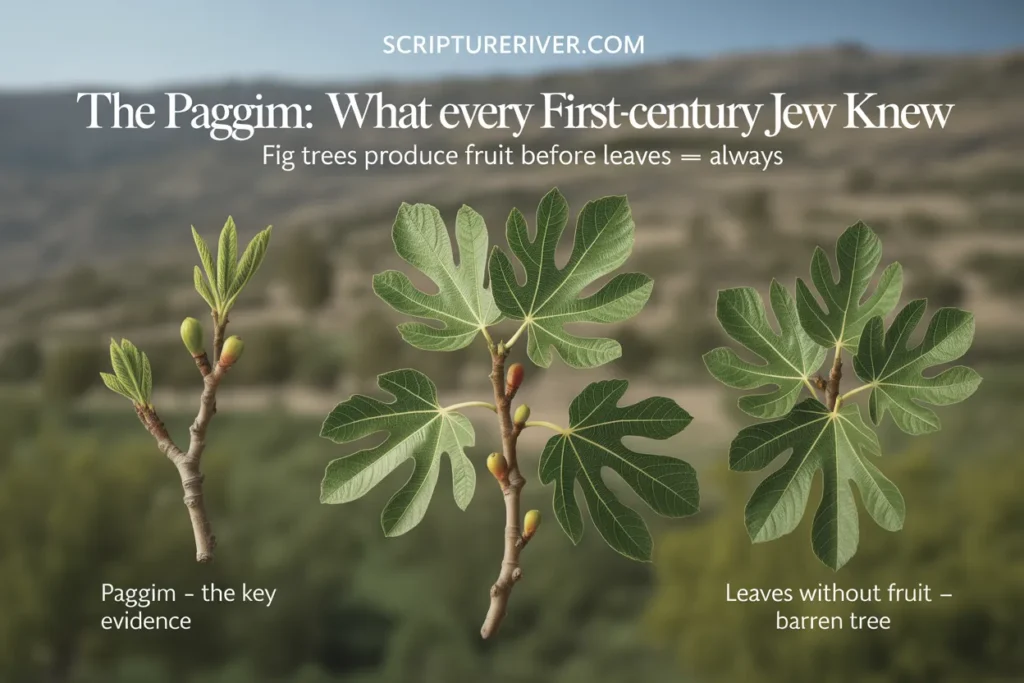
First came the paggim (Hebrew פִּגַּים, mentioned in Song of Solomon 2:13).
These were small, green, unripe fig knobs that appeared in late winter or early spring, developing alongside the leaves.
Ancient sources called them “taqsh” in Aramaic.
While not as sweet as ripe figs, paggim were edible. Travelers and poor people regularly ate them.
They served as an early food source during the lean months before the main harvest.
The bikkurah or “early ripe fig” (mentioned in Micah 7:1, Isaiah 28:4, and Hosea 9:10) ripened around June.
This was the first proper crop, growing from “old wood” (the previous year’s branches).
The kermus or summer fig was the main crop, ripening in August and September.
This grew on “new wood” (spring shoots) and constituted the primary harvest.
The Critical Detail: Leaves Before Fruit Was Impossible
Here’s what every Jewish person in first-century Palestine would have known: fig trees produce fruit before leaves appear.
This isn’t a minor detail. It’s fundamental to fig tree biology.
When a fig tree begins its growing cycle, tiny fig knobs (paggim) develop in the leaf axils before the leaves unfold.
As botanist W. M. Thomson documented in his 19th-century research in Lebanon, the appearance of leaves signals that fruit should already be present.
A fig tree covered in leaves in March or April was making a bold promise: “I have fruit.”
This is why Jesus approached the tree.
Its full foliage wasn’t just unusual. It was a declaration. The leaves announced fruit availability.
What Jesus Found: False Advertising
When Jesus reached the tree, He found “nothing but leaves.”
No paggim. No early figs.
Not even the small, taqsh knobs that any leaf-covered tree should have displayed.
The tree was barren. Completely fruitless.
Despite its impressive foliage, it would never produce the June bikkurah or the August kermus because it lacked the foundational paggim.
Jesus, who created fig trees, knew exactly what this meant: the tree was spiritually and agriculturally worthless.
All show, no substance. Leaves covering barrenness.
The Archaeological Context: 7,000 Years of Fig Cultivation
One of Humanity’s Oldest Crops
Recent archaeological discoveries have revolutionized our understanding of fig cultivation in the ancient Near East.
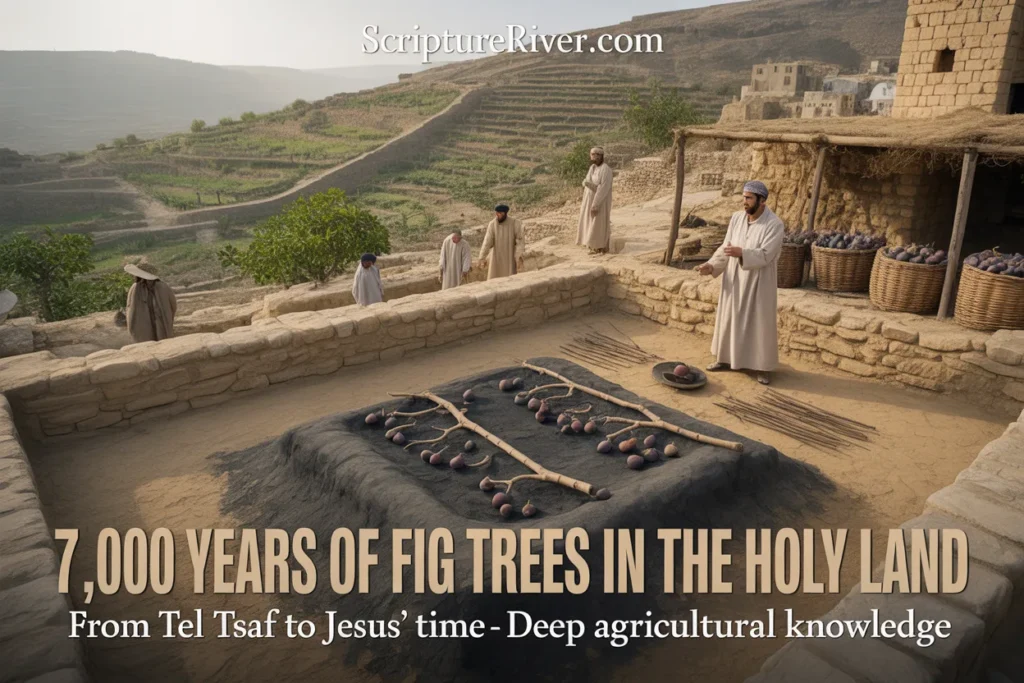
A 2022 study published in Scientific Reports documented charcoal remains from Tel Tsaf in the Jordan Valley, dated to approximately 7,000 years ago (Early Chalcolithic period).
Researchers identified wood from both olive and fig trees, including young fig branches, “most probably from pruning.”
The presence of pruned fig branches is critical evidence.
Fig wood has little value for firewood or construction.
The only reason to have young fig branches in a settlement is pruning to increase fruit yield.
This pushes fig cultivation in Palestine back to 7,000 years before Jesus walked that road from Bethany.
Even more remarkably, a study from Gilgal I near ancient Jericho suggests fig domestication may date to 11,400 years ago, predating wheat and barley cultivation by roughly 1,000 years.
Figs weren’t just present in first-century Palestine.
They were embedded in the agricultural, economic, and cultural identity of the land for millennia.
Palestinian Fig Cultivation in Jesus’ Time
According to the Palestinian Museum’s research on traditional agriculture, Palestinian farmers distinguished multiple stages of fig development with specific terminology:
When forming, the fruit is called taqsh, then faj, then ‘ajr.
The terms nafal and thbeel were also used.
The drying season had two main periods: the dafoor (first crop in May-June with modest yield) and the main crop beginning in July.
Palestinian farmers grew numerous varieties: anaqi, suwwadi, ihmari, ihmadi, imwazi, ikhdari, khartamani, kharubi, and ajlouni.
Districts like Nablus (especially the village of Tell) and Ramallah (particularly Silwad, known as “Im-Qutteen,” meaning “mother of dried figs”) were renowned for fig production.
Villages were named after figs.
Flat areas called masateeh referred specifically to places where figs were dried to produce qutteen (dried figs).
Traditional Palestinian sayings reflected figs’ importance:
“I tasted the first fruit, I hope my life has a long route.”
“Eat the figs from the early season and the grapes from the late season.”
“If we have qutteen (dried figs), we are safe from hunger.”
Fig Trees in Biblical Israel’s Economy
According to the Wikipedia entry on fig domestication, figs were one of the Seven Species mentioned in Deuteronomy 8:7-8, representing the fertility of the Promised Land.
Archaeological evidence from Tel Beit Shemesh revealed pressed figs stored in jars.
Fig cakes (mentioned throughout Scripture) were a portable, long-lasting food source for travel and warfare.
The International Standard Bible Encyclopedia notes that riding “a few miles among the mountain villages of Palestine, with their extensive fig gardens,” reveals “what a long-lasting injury would be the destruction of these slow-growing trees.”
Fig trees required years of patient cultivation.
Luke 13:7 references a farmer who had tended a fig tree for three years without fruit.
Destroying a mature fig tree meant destroying decades of investment.
The Symbolic Meaning: Israel as a Fig Tree
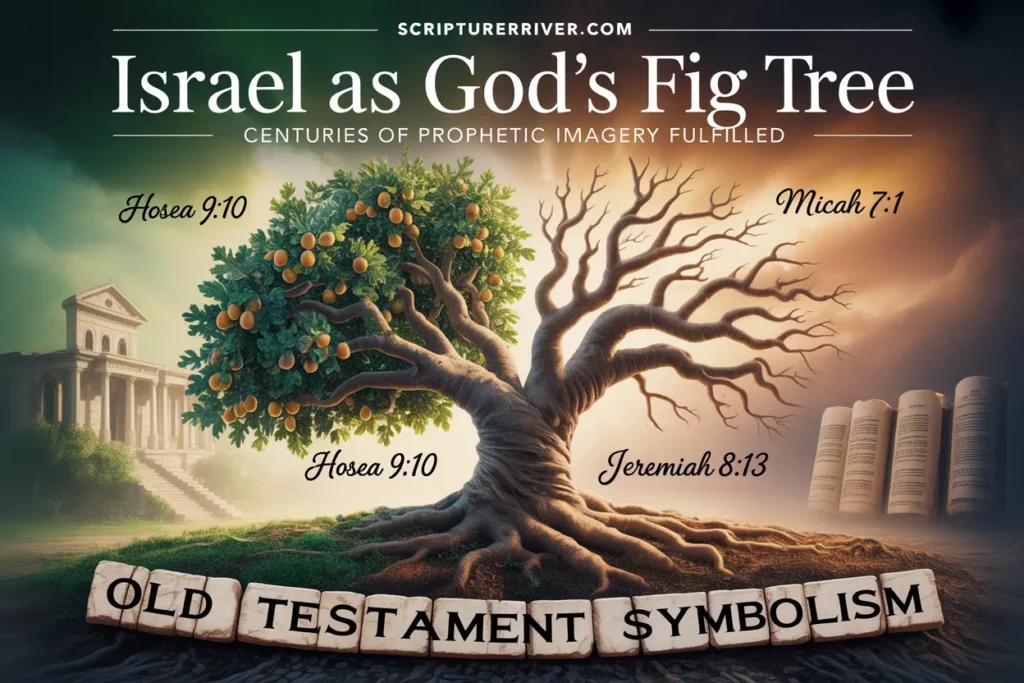
Deep Old Testament Roots
The fig tree wasn’t a random symbol Jesus chose arbitrarily.
It carried layers of meaning every Jewish listener would have immediately recognized.
Throughout the Hebrew Bible, the fig tree symbolized Israel, particularly regarding fruitfulness or barrenness in relationship with God.
Micah 7:1-2 laments: “Woe is me! For I am like one who, when the summer fruit has been gathered, finds no cluster of grapes; no first-ripe fig that my soul desires. The godly has perished from the earth.”
The prophet connects the absence of early figs directly to spiritual barrenness.
Jeremiah 8:13 declares God’s judgment: “When I would gather them, declares the LORD, there are no grapes on the vine, nor figs on the fig tree; even the leaves are withered.”
Joel 1:7 describes enemy invasion: “He has laid waste my vine and splintered my fig tree; he has stripped off their bark and thrown it down; their branches are made white.”
Hosea 9:10 uses figs positively to describe Israel’s early relationship with God: “Like grapes in the wilderness, I found Israel. Like the first fruit on the fig tree in its first season, I saw your fathers.”
Amos, the “fig-pricker” (Amos 7:14), used fig imagery extensively in his prophecies. The Hebrew word kayitz (summer fruit/figs) sounds similar to ketz (the end), creating wordplay about Israel’s coming judgment.
The pattern is consistent: fig trees bearing fruit represent Israel faithful to God; barren fig trees represent Israel’s spiritual failure.
Jesus’ Own Prior Teaching
Jesus had already used barren fig tree imagery in His teaching.
In Luke 13:6-9, He told a parable: “A man had a fig tree planted in his vineyard, and he came seeking fruit on it and found none. And he said to the vinedresser, ‘Look, for three years now I have come seeking fruit on this fig tree, and I find none. Cut it down. Why should it use up the ground?’ And he answered him, ‘Sir, let it alone this year also, until I dig around it and put on manure. Then if it should bear fruit next year, well and good; but if not, you can cut it down.'”
This parable, told months before the cursing incident, established the framework: God expected fruit from Israel, had patiently waited, and judgment was imminent if fruitfulness didn’t appear.
The cursing of the literal fig tree enacted what the parable had announced.
The Genesis Connection Most Miss
Catholic Answers Magazine and several scholars note a profound detail usually overlooked: Genesis 3:7 records that Adam and Eve, after sinning, “sewed fig leaves together and made themselves loincloths.”
Fig leaves were humanity’s first attempt at covering shame and sin through self-effort.
When Jesus found a fig tree with “nothing but leaves,” the symbolism was multilayered.
Like Adam and Eve, Israel’s religious leaders were using fig leaves (external religious observance) to cover their spiritual nakedness.
This connects to Jesus’ frequent criticism of the Pharisees for their focus on external righteousness while harboring inner corruption.
The Temple Connection: Mark’s Literary Sandwich
Why Mark Splits the Story
Mark’s Gospel presents the fig tree event in two parts with the temple cleansing between:
Day 1 (Mark 11:12-14): Jesus curses the fig tree on the way to Jerusalem.
Day 1 (Mark 11:15-19): Jesus cleanses the temple, overturning tables and driving out merchants.
Day 2 (Mark 11:20-21): Disciples notice the withered fig tree.
This “sandwich” structure (technically called intercalation) is Mark’s way of saying: “These events interpret each other.”
The Temple as a Fruitless Fig Tree
When Jesus entered the temple, He found exactly what He’d found on the fig tree: impressive appearance, no fruit.
The temple in Jerusalem was stunning.
Herod’s renovations had made it one of the ancient world’s architectural marvels.
The worship was elaborate. Priests performed sacrifices. Music filled the courts. Passover pilgrims thronged the courtyards.
But Jesus declared it “a den of robbers” instead of “a house of prayer for all nations” (Mark 11:17, quoting Isaiah 56:7 and Jeremiah 7:11).
According to Crossway’s ESV Expository Commentary, rabbinic sources suggest that Caiaphas the high priest had recently moved the sale of sacrificial animals from the valley near Jerusalem into the Court of the Gentiles (the outer court where non-Jews could worship).
This commercial activity made prayer impossible for Gentiles.
The noise, animal smells, and haggling over prices transformed the one space where non-Jews could seek God into a marketplace.
The temple had leaves (impressive rituals, beautiful buildings, crowds of worshipers) but no fruit (no true worship, no justice, no mercy, no welcome for Gentiles, no genuine relationship with God).
Like the fig tree, it was all show.
The Fig Leaves of Religious Performance
Both the fig tree and the temple shared the same problem: external display covering internal barrenness.
The religious leaders had:
- Impressive robes and phylacteries (Matthew 23:5)
- Long public prayers (Matthew 23:14)
- Meticulous tithing of herbs (Matthew 23:23)
- Clean cups and dishes (Matthew 23:25)
- Beautiful tombs (Matthew 23:27-28)
But they lacked:
- Justice, mercy, and faithfulness (Matthew 23:23)
- Love for God and neighbor (Matthew 22:37-40)
- Righteousness that exceeded external rule-keeping (Matthew 5:20)
Jesus’ prophetic act with the fig tree was visual prophecy.
The barren tree represented Israel’s barren religious system, which would soon face judgment just as devastating as the withered fig tree.
The Prophecy: AD 70 and the Temple’s Destruction
Jesus’ Explicit Prediction
Immediately after cursing the fig tree and cleansing the temple, Jesus prophesied the temple’s destruction.
In Mark 13:1-2, the disciples marveled at the temple stones. “Look, Teacher, what wonderful stones and what wonderful buildings!”
Jesus responded: “Do you see these great buildings? There will not be left here one stone upon another that will not be thrown down.”
Forty Years Later
In AD 70, Roman legions under Titus besieged Jerusalem.
When the city fell, the temple was burned. Soldiers tore apart the stones searching for gold that had melted in the fire.
Jesus’ prophecy was fulfilled literally.
The magnificent temple, with its massive stones (some weighing over 100 tons), was dismantled.
Like the fig tree, it was torn up from its roots.
The Fig Tree as Enacted Prophecy
Biblical scholars recognize the cursing of the fig tree as a “prophetic sign-act,” similar to Old Testament prophets’ symbolic actions.
Jeremiah shattered a clay pot to symbolize Jerusalem’s coming destruction (Jeremiah 19:1-11).
Ezekiel lay on his side for 390 days to symbolize Israel’s punishment (Ezekiel 4:4-6).
Hosea married an unfaithful woman to symbolize Israel’s spiritual adultery (Hosea 1:2).
Jesus cursed a fig tree to symbolize judgment on fruitless Israel.
This wasn’t capricious anger. It was prophetic demonstration.
What This Reveals About Jesus
Not Ignorance, But Intimate Knowledge
Far from displaying ignorance about fig trees, Jesus demonstrated profound agricultural expertise.
He knew that a tree in full leaf should have paggim.
He knew that absence of paggim meant the tree would never bear fruit.
He knew the symbolic meaning of figs in Israel’s Scripture and culture.
He knew the prophetic moment required enacted judgment.
Not Anger, But Anguish
The cursing wasn’t rage at a tree. It was grief over Israel.
Luke 19:41-44 records that as Jesus approached Jerusalem, “he wept over it, saying, ‘Would that you, even you, had known on this day the things that make for peace! But now they are hidden from your eyes. For the days will come upon you, when your enemies will set up a barricade around you and surround you and hem you in on every side and tear you down to the ground, you and your children within you.'”
Jesus wasn’t angry at the fig tree. He was heartbroken over Israel’s spiritual condition.
The tree simply provided a teaching moment to reveal what He already knew: judgment was coming on fruitless religion.
Not Injustice, But Warning
Critics like Bertrand Russell miss the point entirely by treating the fig tree as if it had moral agency.
The tree wasn’t being punished. It was being used as an object lesson.
Nobody objects when prophets shatter pottery or tear garments as symbolic acts. The fig tree served the same purpose.
More importantly, Jesus’ action was a warning, not just a judgment. The disciples were being shown what fruitless religion leads to: withering and death.
The message was urgent: bear fruit or face consequences.
The Practical Application: Faith, Prayer, and Fruitfulness
The Disciples’ Question
Mark 11:21-25 records that after seeing the withered tree, Peter exclaimed, “Rabbi, look! The fig tree you cursed has withered!”
Jesus’ response seems to shift topics entirely: “Have faith in God. Truly, I say to you, whoever says to this mountain, ‘Be taken up and thrown into the sea,’ and does not doubt in his heart, but believes that what he says will come to pass, it will be done for him. Therefore I tell you, whatever you ask in prayer, believe that you have received it, and it will be yours. And whenever you stand praying, forgive, if you have anything against anyone, so that your Father also who is in heaven may forgive you your trespasses.”
The Connection to Prayer
Why does Jesus pivot from a withered fig tree to teaching on prayer?
Because the disciples are about to become the new caretakers of God’s people (as The Gospel Coalition notes in their analysis).
The old system (represented by the fig tree and temple) is passing away.
A new covenant community will emerge.
These disciples will need faith to sustain them through the coming crisis.
They’ll need prayer to remain connected to God. They’ll need forgiveness to maintain unity.
Most critically, they’ll need to bear fruit.
The Warning to All Believers
The fig tree account isn’t just about historical Israel. It’s about every person and community that claims to follow God.
Church history is littered with movements that started vibrant and ended barren.
Denominations that once preached the gospel powerfully but now maintain buildings without life.
Individuals who profess faith but produce no fruit.
Jesus’ warning echoes through centuries: appearance without reality leads to withering.
Frequently Asked Questions
Wasn’t Jesus being unfair to curse a tree for something beyond its control?
The fig tree had no moral agency. It wasn’t being punished. Jesus was using it as a prophetic sign, just as Old Testament prophets used physical objects for symbolic demonstrations.
The real audience wasn’t the tree. It was the disciples, who needed to understand that fruitless religion faces judgment.
If it wasn’t the season for figs, how could Jesus expect to find any?
This question misunderstands fig tree biology in first-century Palestine. While the main harvest came in summer, fig trees produced edible paggim (small fig knobs) in spring alongside their leaves.
A tree displaying full foliage in March/April should have had paggim. The absence of these early figs indicated the tree would never bear fruit at any season.
Why did Jesus use such a harsh method to make His point?
The urgency of the moment demanded vivid demonstration. Jesus was days away from crucifixion. The disciples needed to grasp that the entire religious system was about to collapse.
A withered fig tree provided an unforgettable visual lesson about what happens to fruitless religion.
Was Jesus hungry and acting out of frustration?
The text mentions Jesus was hungry, but His actions weren’t impulsive or petulant. Everything Jesus did was purposeful and pedagogical.
The hunger may have been providential, giving Him a natural reason to approach the tree and create a teaching moment.
How does this apply to Christians today?
Every believer and church must ask: Are we producing fruit, or just maintaining appearances? Are we truly worshiping God, or performing religious activities?
Jesus seeks righteousness, justice, mercy, love, and faithfulness. External religious observance without these qualities is as worthless as a leafy tree without fruit.
What kind of fruit was Jesus looking for?
Galatians 5:22-23 lists the fruit of the Spirit: love, joy, peace, patience, kindness, goodness, faithfulness, gentleness, self-control.
Jesus also described fruit in terms of making disciples (John 15:8), living righteously (Matthew 7:16-20), and demonstrating transformed character.
The Pharisees had religious activity but lacked love for God and neighbor. That’s the barrenness Jesus condemned.
A Prayer for Fruitfulness
Lord Jesus, You who walked that road from Bethany and saw what others missed, open our eyes to see ourselves truly.
We confess how easily we cultivate leaves while neglecting fruit. We polish our external image while our hearts remain barren. We perform religious duties while lacking genuine love.
Forgive us for presenting an impressive appearance to others while You find nothing but leaves when You inspect our lives.
We don’t want to be like that fig tree, all show and no substance. We don’t want to face the withering that comes from fruitlessness.
Teach us to bear real fruit: love that sacrifices, joy that sustains, peace that transcends circumstances, patience that endures, kindness that gives, goodness that chooses right, faithfulness that perseveres, gentleness that honors, self-control that resists.
You created us to bear fruit. You pruned us to increase our yield. You provide everything we need for fruitfulness through abiding in You.
May our lives produce genuine spiritual fruit that glorifies You and blesses others. May we never be content with mere religious appearance.
Keep us connected to You, the True Vine, so that our fruitfulness flows from Your life in us, not from our own striving.
When You inspect our lives, may You find the fruit You seek. Not perfect fruit, but real fruit. Not impressive quantities, but authentic quality.
We ask this in Your name, the One who cursed barrenness and blessed fruitfulness. Amen.
Resources and Further Study
Catholic Answers Magazine. (2024). Why does Jesus curse the fig tree? [Theological analysis]
Crossway. (2023). Why did Jesus curse a fig tree? [ESV Expository Commentary]
Defending Inerrancy. (n.d.). Matthew 21:12-19 harmony with Mark 11:12-14 [Biblical harmonization]
Got Questions. (2007). Why did Jesus curse the fig tree? [Apologetics resource]
Gutenberg College. (2023). Making sense of Jesus cursing the fig tree [Literary analysis]
International Standard Bible Encyclopedia. (n.d.). Fig, fig-tree [Biblical encyclopedia]
Langgut, D., & Sasi, A. (2022). 7000-year-old evidence of fruit tree cultivation in the Jordan Valley, Israel. Scientific Reports [Archaeological study]
McClintock and Strong Biblical Cyclopedia. (n.d.). Fig-tree, cursed [Historical biblical resource]
The Gospel Coalition. (2018). Why did Jesus curse the fig tree? [Theological article]
Wikipedia. (2025). Cursing of the fig tree [Reference encyclopedia]

