

Have you ever been asked your name and struggled to find words that capture who you truly are?
Your name is just a label, a sound people use to get your attention.
But what if someone asked you not just what your name is, but what your name means?
What if they wanted you to explain the essence of your existence in a single phrase?
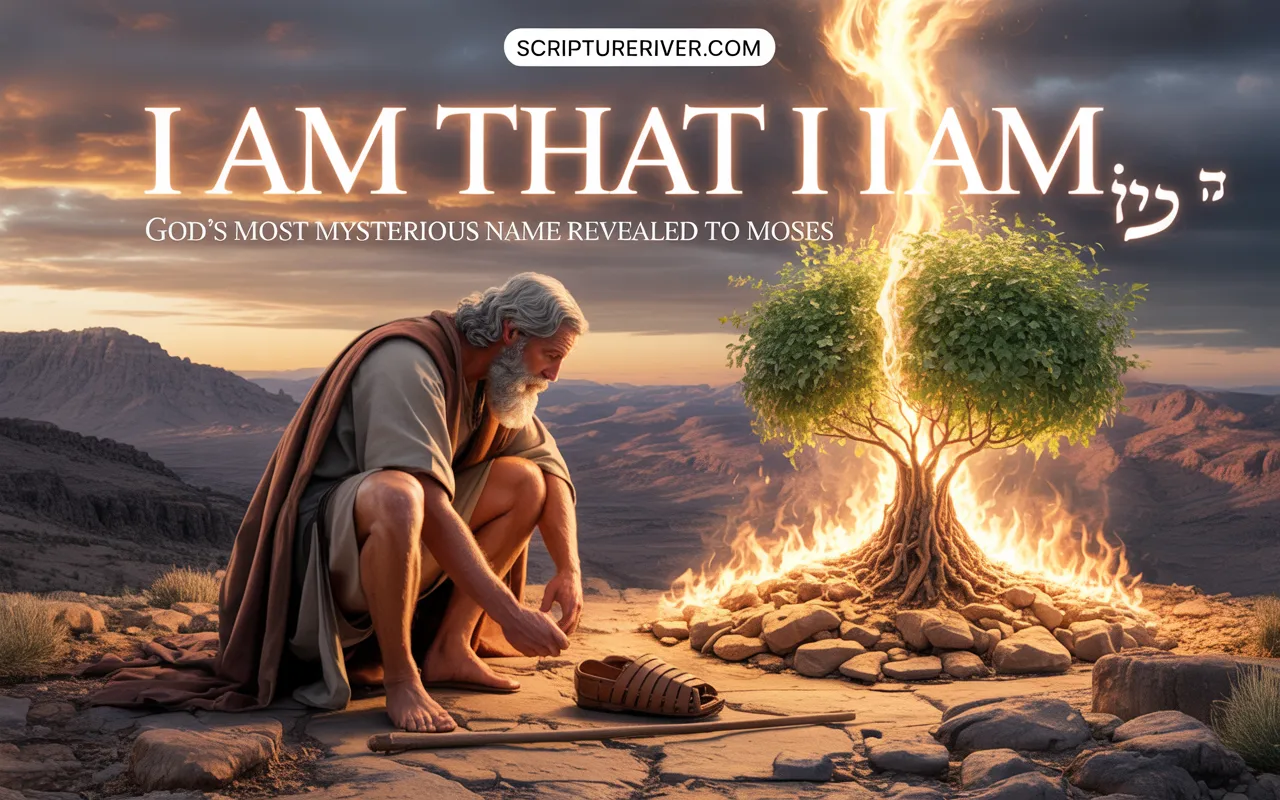
This was Moses’ dilemma at the burning bush.
Standing on holy ground, removing his sandals, Moses faced the God of his ancestors and asked the most profound question any human has ever posed: “What is your name?” God’s answer has echoed through 3,500 years of history, theology, and human wonder: “I AM THAT I AM.”
This wasn’t just God giving Moses a label to use.
It was God revealing something about His very nature that the human mind can barely comprehend.
This post will explore the Hebrew meaning, theological depth, and life-transforming implications of the most mysterious name ever spoken.
The Context: Why Moses Asked for God’s Name
Moses’ Identity Crisis
Moses’ life was a mess.
Born Hebrew, raised Egyptian, now an exiled shepherd in Midian.
He murdered an Egyptian officer, fled for his life, and spent 40 years tending sheep in the wilderness.
He married Zipporah, daughter of Jethro (whose title means “His Excellence”), and settled into obscurity.
Meanwhile, back in Egypt, the Hebrews remained enslaved under a Pharaoh “who did not know Joseph” (Exodus 1:8).
Four hundred years of captivity. Four hundred years of crying out for deliverance. Four hundred years of silence from the God who promised Abraham that his descendants would be blessed.
Then came the burning bush.
The Question Behind the Question
When Moses asked “What is his name?” (Exodus 3:13), he wasn’t asking for pronunciation tips.
Hebrew scholar Dr. Terry Harman explains that Moses used the Hebrew word mah (what), not mi (who).
The word mah “invites an answer which goes further, and gives the meaning (‘what?’) or substance of the name.”
Moses was asking: “What does your name mean? What is its substance? Who are you really?”
Here’s why this mattered: The Hebrews had lived in Egypt for four centuries, surrounded by gods with names that declared their attributes.
Ra (sun god), Osiris (god of the afterlife), Anubis (god of mummification).
Each Egyptian deity had a name that explained their function.
Moses knew the Israelites would ask: “What god sent you? What’s his specialty? What can he do that Egypt’s gods cannot?”
Moses needed more than a sound. He needed substance.
The Hebrew: Ehyeh Asher Ehyeh (אֶהְיֶה אֲשֶׁר אֶהְיֶה)
What Most Christians Don’t Know About the Translation
The Hebrew phrase God spoke is ehyeh asher ehyeh (pronounced eh-YEH ah-SHER eh-YEH).
Most English Bibles translate this as “I AM THAT I AM” (KJV, NKJV, ESV) or “I AM WHO I AM” (NIV, NASB).
But here’s what most Christians never learn: these translations may actually be incorrect.
The word ehyeh (אֶהְיֶה) comes from the Hebrew root hayah (הָיָה), meaning “to be,” “to exist,” “to become,” or “to happen.”
Ehyeh is the first-person singular imperfect form of this verb.
The Hebrew Tense Problem
Here’s the crucial issue: Biblical Hebrew didn’t have past, present, and future tenses like English.
Instead, it had an aspectual system with two forms:
Perfect: Completed actions (what we might call “past tense”)
Imperfect: Incomplete or ongoing actions (what we might call “future tense”)
The word ehyeh is in the imperfect form.
In Modern Hebrew, this would definitely mean future tense: “I will be.”
But in Biblical Hebrew, without the prefix wa- (which inverts the aspect), ehyeh could mean:
- “I am”
- “I will be”
- “I may be”
- “I would be”
- “I could be”
- “I am becoming”
How Different Translations Handle This
Future Tense Translations:
- Matthew’s Bible (1549): “I will be what I will be”
- Rotherham’s Translation: “I will become”
- Moffatt Translation: “I WILL BE”
- Concordant Literal Version: “I-SHALL-COME-TO-BE”
Present Tense Translations:
- King James Version: “I AM THAT I AM”
- New International Version: “I AM WHO I AM”
- English Standard Version: “I AM WHO I AM”
The RSV, NRSV, NEB, and REB all include “I WILL BE” as a footnote option, acknowledging the ambiguity.
Why the Debate Matters
If God said “I WILL BE WHAT I WILL BE,” He’s making a promise about His future faithfulness.
If He said “I AM WHO I AM,” He’s declaring His eternal, unchanging existence.
Both are theologically profound, but they emphasize different aspects of God’s nature.
Dennis Prager notes in The Rational Bible that “Hebrew does not have a word for the present tense of the verb ‘to be.'”
There is no Hebrew equivalent to “is” or “are.”
Therefore, to say “I am Joseph” in Hebrew, you would simply say “Ani Joseph” (I Joseph).
This linguistic reality makes the phrase ehyeh asher ehyeh all the more mysterious and pregnant with meaning.
The Connection to YHWH (The Tetragrammaton)
From Ehyeh to YHWH
Immediately after God says “Ehyeh asher ehyeh,” He gives Moses a related name to use with Israel: YHWH (יהוה), known as the Tetragrammaton (Greek for “four letters”).
This name appears over 6,800 times in the Hebrew Bible.
The connection is clear: Ehyeh is first person (“I am” or “I will be”), while YHWH is third person (“He is” or “He will be”).
Both come from the same verbal root hayah.
YHWH (Yod-Heh-Vav-Heh) is the third-person imperfect form of hayah.
This name became so sacred to the Jewish people that they stopped pronouncing it entirely after the Babylonian Exile (6th century BCE).
Instead, they would say “Adonai” (Lord) or “HaShem” (The Name).
The Pronunciation Mystery
Ancient Hebrew was written with consonants only.
We know the letters are Y-H-W-H, but we don’t know with certainty how it was pronounced.
Scholars believe the most likely pronunciation is “Yahweh” (YAH-way or YAH-weh), based on theophoric names like Yeshayahu (Isaiah), early Christian testimonies from Theodoret noting Samaritans pronounced it as “Iabe,” and Greek transliterations like “Iao.”
The name “Jehovah” is actually a medieval mistake.
Jewish scribes (Masoretes) added vowel points to YHWH from “Adonai” to remind readers to say “Lord” instead.
Later Christian scholars who didn’t understand this practice combined the consonants of YHWH with the vowels of Adonai, creating “Jehovah.”
What “I AM THAT I AM” Means Theologically
1. God Is Self-Existent
Unlike everything else in the universe, God doesn’t derive His existence from anything or anyone.
He simply IS.
He wasn’t created, He wasn’t caused, He doesn’t depend on external circumstances.
Philosophers call this “aseity” (from Latin a se, “from himself”).
Everything else exists because something else caused it to exist. You exist because your parents existed. The earth exists because of cosmic forces.
But God? He exists because He IS existence itself.
2. God Is Eternal and Unchanging
The phrase ehyeh asher ehyeh suggests a continuity that transcends time.
Whether we translate it as “I am” or “I will be,” the name encompasses past, present, and future.
Some scholars suggest YHWH could be understood as “He who will be, who is, and who has been,” capturing all three temporal dimensions simultaneously.
God doesn’t change with circumstances. He wasn’t different in Moses’ day than He will be in ours. Malachi 3:6 confirms this: “I the LORD do not change.”
3. God Is Sufficient in Himself
By saying “I AM THAT I AM,” God is essentially saying, “I am complete in myself. I need nothing outside myself to be who I am. My existence, My character, My power, My purposes don’t depend on creation, on human cooperation, or on external validation.”
This is profoundly countercultural. We define ourselves by relationships, achievements, possessions. God defines Himself by Himself.
4. God Refuses to Be Limited by Human Categories
Some scholars interpret ehyeh asher ehyeh as deliberately enigmatic, even evasive.
God may be saying, “I will be what I choose to be. You cannot box Me into your categories or control Me with religious formulas.”
Throughout Israel’s history, God revealed Himself as whatever His people needed:
- Provider (Jehovah-Jireh)
- Healer (Jehovah-Rapha)
- Banner/Victory (Jehovah-Nissi)
- Peace (Jehovah-Shalom)
- Shepherd (Jehovah-Rohi)
- Righteousness (Jehovah-Tsidkenu)
- Ever-Present (Jehovah-Shammah)
5. God Is Actively Present, Not Abstractly Philosophical
The Chicago Bible Students explain: “By using the translation ‘I will become whatsoever I may become,’ we see the relationship of this phrase to Yahweh, ‘He who becometh.’
The use of ehyeh asher ehyeh was God’s way of assuring and pledging to Moses and Israel that God would become whatever they needed Him to become.”
This isn’t God announcing His philosophical essence in an ivory tower. It’s God making a covenant promise: “I will be with you. I will be what you need Me to be to deliver you.”
Jesus and “I AM”
The New Testament Connection
In the Gospel of John, Jesus makes seven famous “I AM” statements:
- “I am the bread of life” (John 6:35)
- “I am the light of the world” (John 8:12)
- “I am the door” (John 10:9)
- “I am the good shepherd” (John 10:11)
- “I am the resurrection and the life” (John 11:25)
- “I am the way, the truth, and the life” (John 14:6)
- “I am the true vine” (John 15:1)
But the most controversial statement appears in John 8:58: “Before Abraham was, I am” (ego eimi in Greek).
The Jewish leaders immediately picked up stones to kill Him for blasphemy because they understood He was claiming to be YHWH, the “I AM” of Exodus 3:14.
The Greek Connection
The Septuagint (Greek translation of the Hebrew Bible from 250 BCE) translated ehyeh asher ehyeh as ego eimi ho on (“I am the Being”). When Jesus uses ego eimi (“I am”) in John’s Gospel, He’s deliberately echoing God’s self-revelation to Moses.
In John 18:5-6, when soldiers come to arrest Jesus and He says “I am” (ego eimi), they literally fall to the ground.
This wasn’t fear of a man. It was an involuntary response to hearing the divine Name spoken with divine authority.
Frequently Asked Questions
Why did God use such a mysterious name instead of something simple?
The mystery is intentional. God’s name wasn’t meant to be a label that humans could control or manipulate, like ancient peoples believed knowing a deity’s name gave them power over that deity. By giving a name that essentially means “I AM,” God reveals that He cannot be contained, controlled, or fully comprehended by human understanding. His name invites relationship but maintains His transcendence.
Additionally, as theologian Elmer Martens notes, the name emphasizes “presence to act.” God wasn’t revealing His inner metaphysical nature to Moses. He was assuring Moses, “I am present with you to act on your behalf.” The vagueness of the name allows it to be filled with meaning through God’s actions in history.
Is “I AM THAT I AM” the correct translation or should it be “I WILL BE WHAT I WILL BE”?
Both are linguistically valid, and the ambiguity may be intentional. The Hebrew imperfect form ehyeh can express both present and future. “I AM THAT I AM” emphasizes God’s eternal, unchanging nature and self-existence. “I WILL BE WHAT I WILL BE” emphasizes God’s dynamic presence and His promise to be whatever His people need.
Many modern scholars prefer “I will be what I will be” because it fits the immediate context better. God is sending Moses to deliver Israel from Egypt. The promise “I will be with you” (Exodus 3:12) suggests God is emphasizing His future faithfulness, not making a philosophical statement about His being.
However, the traditional “I AM” translation has theological merit because it captures God’s eternal nature and connects beautifully to Jesus’ “I AM” statements in John’s Gospel.
What is the difference between YHWH, Yahweh, Jehovah, and LORD?
YHWH: The four Hebrew consonants that form God’s personal name (the Tetragrammaton).
Yahweh: The scholarly reconstruction of how YHWH was most likely pronounced in ancient times, based on linguistic evidence. This is not certain, as the original pronunciation was lost when Jews stopped saying the name aloud.
Jehovah: A medieval hybrid created by mistakenly combining the consonants of YHWH with the vowels of Adonai (Lord). While historically inaccurate, it became widespread through the King James Version and continues to be used in some Christian traditions.
LORD (in small capitals): The English convention used in most modern Bibles to indicate where YHWH appears in the Hebrew text, following the Jewish practice of saying “Adonai” (Lord) instead of pronouncing the divine name.
Why did Jews stop pronouncing God’s name?
Several reasons converged:
- Reverence: As Judaism developed, increasing emphasis was placed on the sacredness of God’s name, taking seriously the commandment not to “take the name of the LORD your God in vain” (Exodus 20:7).
- Temple practice: Eventually, only the High Priest was allowed to pronounce YHWH, and only once a year on the Day of Atonement (Yom Kippur).
- Post-exile theology: After the Babylonian Exile, the term “Elohim” (God) became more common as Judaism emphasized God’s universal sovereignty over all nations, not just Israel.
- Protecting holiness: Scribes and translators would perform ritual purification before copying the name, such was the reverence for it. The practice of substituting “Adonai” emerged to protect against accidental misuse.
After the Second Temple’s destruction in 70 CE, the original pronunciation was lost entirely.
Does the name “I AM” prove Jesus is God?
From a Christian theological perspective, yes. The connection between Exodus 3:14 and Jesus’ “I AM” statements is central to Christology (the study of Christ’s nature). When Jesus said “Before Abraham was, I am” (John 8:58), the Jewish leaders understood He was claiming to be YHWH and attempted to stone Him for blasphemy.
The New Testament consistently applies Old Testament YHWH passages to Jesus:
- Isaiah 40:3 (“Prepare the way of YHWH”) is applied to John preparing the way for Jesus (Matthew 3:3)
- Joel 2:32 (“everyone who calls on the name of YHWH will be saved”) is quoted in Romans 10:13 in reference to Jesus
However, non-Christian Jews and some scholars argue this connection is a Christian interpretation imposed on the text rather than Moses’ original meaning. The debate continues.
Why does God need a name at all if He’s the only true God?
Excellent question. Names in the ancient world served different purposes than simple identification. A name revealed character, established relationship, and created intimacy.
God giving His name to Moses accomplished several things:
- Established covenant relationship: Knowing someone’s name in ancient culture meant having access to them, being in relationship with them.
- Distinguished Himself from false gods: In a polytheistic world, Israel needed a personal name for their God to distinguish Him from Egypt’s deities.
- Provided assurance: The name carried a promise of presence and faithfulness. When Moses told Israel “YHWH sent me,” he was saying “The eternally faithful One, the self-existent God, has sent me.”
- Enabled worship: You cannot pray to “whoever’s out there.” Personal relationship requires personal identification.
How should Christians use God’s name today?
This is a matter of conscience and tradition:
Some Christians follow Jewish practice and avoid pronouncing “Yahweh” out of reverence, preferring “LORD” or “Adonai.”
Other Christians believe that through Christ, believers have access to God’s name and use “Yahweh” freely in worship and prayer.
Most Christians use “LORD” or “God” in regular conversation while respecting the significance of the revealed name.
The principle underlying the third commandment (“You shall not take the name of the LORD your God in vain”) isn’t about pronunciation but about representation. Taking God’s name “in vain” means claiming to represent Him while living in ways that misrepresent His character. We “take” God’s name by identifying ourselves as His people. The question is whether we carry that name with the honor and holiness it deserves.
What does this name teach us about who God is in everyday life?
The name “I AM” teaches us that:
God is present: Not distant or detached, but actively here. His name isn’t “I WAS” (confined to history) or “I WILL BE” (postponed to the future). He is present tense, here and now.
God is sufficient: Whatever you lack, He is. Hungry? He’s the Bread of Life. Lost? He’s the Way. Confused? He’s the Truth. Dead inside? He’s the Resurrection and the Life. His name “I AM” remains open-ended so it can be completed by whatever we need.
God is unchanging: Your circumstances change. Your feelings change. God does not. The One who spoke to Moses is the same One who speaks to you today.
God is incomprehensible: We cannot fully understand Him. His name reminds us that God is not a cosmic vending machine we can manipulate by knowing the right codes. He remains gloriously, mysteriously beyond our complete comprehension.
Prayer for Understanding God’s Name
Father, the great “I AM,”
I confess that I try to reduce You to manageable categories. I want a God I can understand, control, and predict. But Your name declares that You are beyond my comprehension.
Thank You that You are self-existent, depending on nothing outside Yourself. Thank You that You are eternally unchanging, the same yesterday, today, and forever.
Thank You that Your name is a promise: “I will be what I will be.” Whatever I need today, You have already promised to be that for me. If I need strength, You are my strength. If I need wisdom, You are my wisdom. If I need peace, You are my peace.
Forgive me for the times I’ve taken Your name in vain, claiming to represent You while living in ways that dishonor Your character. Help me to carry Your name with holiness.
I worship You as the great “I AM.” You were before all things. You hold all things together. You will remain when all things pass away. You need nothing from me, yet You invite me into relationship with You.
Teach me to live in the reality of Your presence. Let me experience You not as a concept or theology, but as the living God who IS, who acts, who speaks, who saves.
In Jesus’ name, who boldly claimed “I AM” and proved it by defeating death itself, Amen.
Reference Sources
Wikipedia. (2025). I Am that I Am. [Comprehensive linguistic and theological overview]
Harman, T. (2024). Unveiling the mysterious “I am that I am.” The Tabernacle Man. [Biblical and historical analysis]
Israel My Glory. (n.d.). I Am that I am. [Jewish perspective on the divine name]
GotQuestions.org. (2015). What is YHWH? What is the tetragrammaton? [Evangelical explanation]
Christianity.com. (2024). What does YHWH mean? History of the Tetragrammaton. [Historical and theological study]
Bibliaon. (2025). YHWH: The meaning of the Hebrew name for God. [Linguistic analysis]
Bible Analysis. (2025). From YHWH to Yahweh: Decoding the Tetragrammaton. [Scholarly reconstruction]
Britannica. (1998). Yahweh. [Academic reference article]
Ehrman, B. (2024). YHWH: Meaning and etymology of the Tetragrammaton. [Critical scholarly perspective]
Bible Researcher. (n.d.). The translation of the Tetragrammaton. [Translation history and methodology]
Hebrew for Christians. (n.d.). The Hebrew name for God – YHVH. [Hebrew linguistic perspective]
Chicago Bible Students. (n.d.). Why did God call Himself, “I AM THAT I AM”? [Theological interpretation]
Christian Forums. (2014). Why do so many believe ehyeh at Ex. 3:14 means “I AM”? [Translation debate discussion]
Jesus Words Only. (n.d.). Bible study on Exodus 3:14 – Is it truly I am that I am? [Translation accuracy analysis]
Exodus-314.com. (n.d.). Exodus 3:14 meaning and interpretation explained. [Comprehensive exegetical resource]

